Bay Area summers are getting hotter—and less predictable. One week it’s 68°F in San Francisco, and the next it’s 105°F in Livermore. That’s exactly why every homeowner needs a thorough AC summer checklist for the Bay Area before temperatures spike. The worst time to discover your air conditioner isn’t working is during a heat wave when every HVAC tech in the region is booked solid.
This 15-point checklist covers everything from simple filter swaps you can handle in five minutes to professional inspections that prevent costly mid-summer breakdowns. We’ve divided it into 10 DIY tasks and 5 “call a pro” items so you know exactly what to tackle yourself—and when to bring in a licensed technician.
AC Summer Checklist Bay Area: Quick Reference Table
| # | Task | DIY or Pro? | Time Needed | Priority |
| 1 | Replace or clean air filters | DIY | 5–10 min | Critical |
| 2 | Clear debris from outdoor unit | DIY | 15–20 min | High |
| 3 | Inspect and clean supply vents | DIY | 20–30 min | High |
| 4 | Test your thermostat | DIY | 5 min | Critical |
| 5 | Check circuit breakers | DIY | 5 min | High |
| 6 | Clean around indoor air handler | DIY | 10–15 min | Medium |
| 7 | Check your condensate drain line | DIY + Pro | 10–15 min | Critical |
| 8 | Inspect visible ductwork | DIY | 15–20 min | Medium |
| 9 | Test carbon monoxide detectors | DIY | 5 min | Critical |
| 10 | Program your smart thermostat for summer | DIY | 10 min | Medium |
| 11 | Professional refrigerant level check | Pro | 30 min | Critical |
| 12 | Electrical connections & capacitor test | Pro | 20 min | High |
| 13 | Evaporator & condenser coil cleaning | Pro | 45–60 min | High |
| 14 | Full system performance test | Pro | 30–45 min | High |
| 15 | Duct leakage assessment | Pro | 30–45 min | Medium |
DIY Tasks: What You Can Do This Weekend
These 10 items require no special tools or HVAC knowledge. Set aside a Saturday morning and knock them all out before temperatures climb.
1. Replace or Clean Your Air Filters
This is the single most impactful thing you can do for your AC system—and it takes five minutes. A clogged filter forces your system to work harder, drives up your PG&E bill, and can lead to frozen evaporator coils.
What to do: – Locate your return air filter (usually in a hallway ceiling, wall, or at the air handler) – Check the size printed on the filter frame (common sizes: 16x25x1, 20x25x1, 20x25x4) – Replace disposable filters or clean reusable ones with water and let them fully dry – During Bay Area summer, replace standard 1-inch filters every 30–60 days
Bay Area tip: If you live in an area prone to wildfire smoke—Livermore, Walnut Creek, Morgan Hill—consider upgrading to a MERV-13 filter during fire season. It captures fine particulate matter that cheaper filters miss. A dirty filter is also one of the top HVAC issues during hot Bay Area summers. Learn more about how HVAC filters work in Bay Area homes.
2. Clear Debris from Your Outdoor Condenser Unit
Your outdoor unit has been sitting through months of Bay Area winter rain. Leaves, dirt, grass clippings, and even spider webs accumulate around and inside the unit, choking airflow.
What to do: – Turn off the AC system at the thermostat before starting – Remove any leaves, branches, or debris from the top grill and around the base – Trim back any bushes, vines, or plants to maintain at least 2 feet of clearance on all sides – Gently rinse the condenser fins with a garden hose (never a pressure washer) from the inside out – Make sure the unit is level on its concrete pad—settling can cause vibration and refrigerant line stress
3. Inspect and Clean All Supply Vents and Returns
Blocked or dirty vents are a surprisingly common reason Bay Area homeowners call us with “my AC isn’t cooling” complaints. Furniture gets moved during the holidays and never moved back. Rugs cover floor vents. Kids shove toys into registers.
What to do: – Walk through every room and locate each supply vent and return grille – Remove vent covers and vacuum out dust buildup – Make sure no furniture, curtains, or rugs are blocking airflow – Ensure all vents are fully open (closing vents to “save energy” actually increases system strain)
4. Test Your Thermostat
Before the first heat wave hits, make sure your thermostat actually works in cooling mode.
What to do: – Switch from “heat” to “cool” mode – Set the temperature 5 degrees below current room temperature – Wait 3–5 minutes—you should hear the outdoor unit kick on and feel cool air at the supply vents – If you have a programmable or smart thermostat, verify your summer schedule is set correctly – Replace thermostat batteries if it uses them (most Honeywell and Emerson models do)
Pro tip: Set your thermostat to 78°F when you’re home and 85°F when you’re away. This sweet spot balances comfort with efficiency and can cut your cooling costs significantly.
5. Check Your Circuit Breakers
Your AC system has its own dedicated circuit breakers—usually one for the indoor air handler and another for the outdoor condenser. Occasionally these trip during the off-season and nobody notices.
What to do: – Open your electrical panel and find the breakers labeled “AC,” “Air Handler,” “Condenser,” or “HVAC” – Make sure they’re firmly in the ON position (not tripped to the middle) – If a breaker trips again immediately after you reset it, do not keep resetting it—call a professional
6. Clean Around the Indoor Air Handler
Your indoor unit (furnace or air handler) needs breathing room too. During winter, it’s common for storage boxes, holiday decorations, and laundry to pile up nearby.
What to do: – Clear at least 3 feet of space around the air handler – Vacuum any dust from the area – Check for signs of water stains or moisture around the base (this could indicate a drain issue—see #7)
7. Check Your Condensate Drain Line (Don’t Skip This One!)
This is the one most homeowners overlook—and it causes more summer AC emergencies than almost anything else. Your air conditioner doesn’t just cool air; it removes humidity. That moisture has to go somewhere, and it drains through a small PVC pipe called the condensate drain line. When this line clogs with algae, mold, or debris, water backs up into your system. The result? Water damage to ceilings, walls, and floors. Some systems have a safety float switch that shuts off the entire AC when the line clogs—leaving you without cooling on the hottest day of the year.
What to do: – Locate the condensate drain line—it’s a white PVC pipe (usually ¾ inch) coming out of your indoor unit, typically draining outside or into a utility sink – Check that water flows freely when the AC runs – Pour a cup of white vinegar or a 50/50 bleach-and-water solution through the drain access point to kill algae buildup – If the line is already clogged, you can try using a wet/dry vacuum on the outdoor end of the line – Look for a clean-out cap or T-fitting near the indoor unit—this is your access point
Bay Area context: Our humid coastal air means condensate drain lines clog faster here than in drier inland climates. If you live near the coast—Pacifica, Redwood City, San Mateo—add this to your monthly routine during summer. And if your system doesn’t have a safety float switch, schedule a maintenance visit to have one installed. It’s cheap insurance against water damage.
8. Inspect Visible Ductwork for Damage
If you have exposed ductwork in your attic, basement, garage, or crawl space, give it a visual inspection.
What to do: – Look for disconnected joints, crushed flex duct, or obvious tears – Check for gaps where duct connections meet the plenum or registers – Feel for air leaking from joints while the system is running – Note any damaged insulation or sections where ductwork is sagging
Bay Area homes built before 1980 often have aging ductwork that leaks 20–30% of conditioned air. If you find issues, this is one for the pros. Learn more about duct leak detection.
9. Test Your Carbon Monoxide and Smoke Detectors
This isn’t strictly an AC task, but it belongs on every seasonal home safety checklist—and if you have a gas furnace that shares the air handler with your AC, it’s directly relevant.
What to do: press the test button on each CO and smoke alarm; replace replaceable batteries at least once a year; replace smoke alarms every 10 years and CO alarms by the manufacturer's end-of-life date (check the date on the back).
10. Program Your Smart Thermostat for Summer Schedules
If you have a Nest, Ecobee, Honeywell, or similar smart thermostat, update your schedule for summer.
What to do: – Set a summer schedule: 78°F when home, 85°F when away, 76°F for sleeping – Enable “eco” or “away” modes for when the house is empty – If you have a smart thermostat with learning capabilities, let it run for a few days after setting up so it can learn your patterns – Check your app to make sure the Wi-Fi connection is stable and you’re getting alerts
Call a Pro: 5 Tasks That Require a Licensed AC Technician
These items involve specialized tools, refrigerant handling (which requires EPA certification), or electrical work. Schedule a professional tune-up to cover all five at once.
11. Professional Refrigerant Level Check
Low refrigerant means your system runs longer, cools less, and costs more. But here’s what most homeowners don’t know: air conditioners don’t “use up” refrigerant. If your levels are low, you have a leak—and simply topping off the charge without finding and fixing the leak is throwing money away.
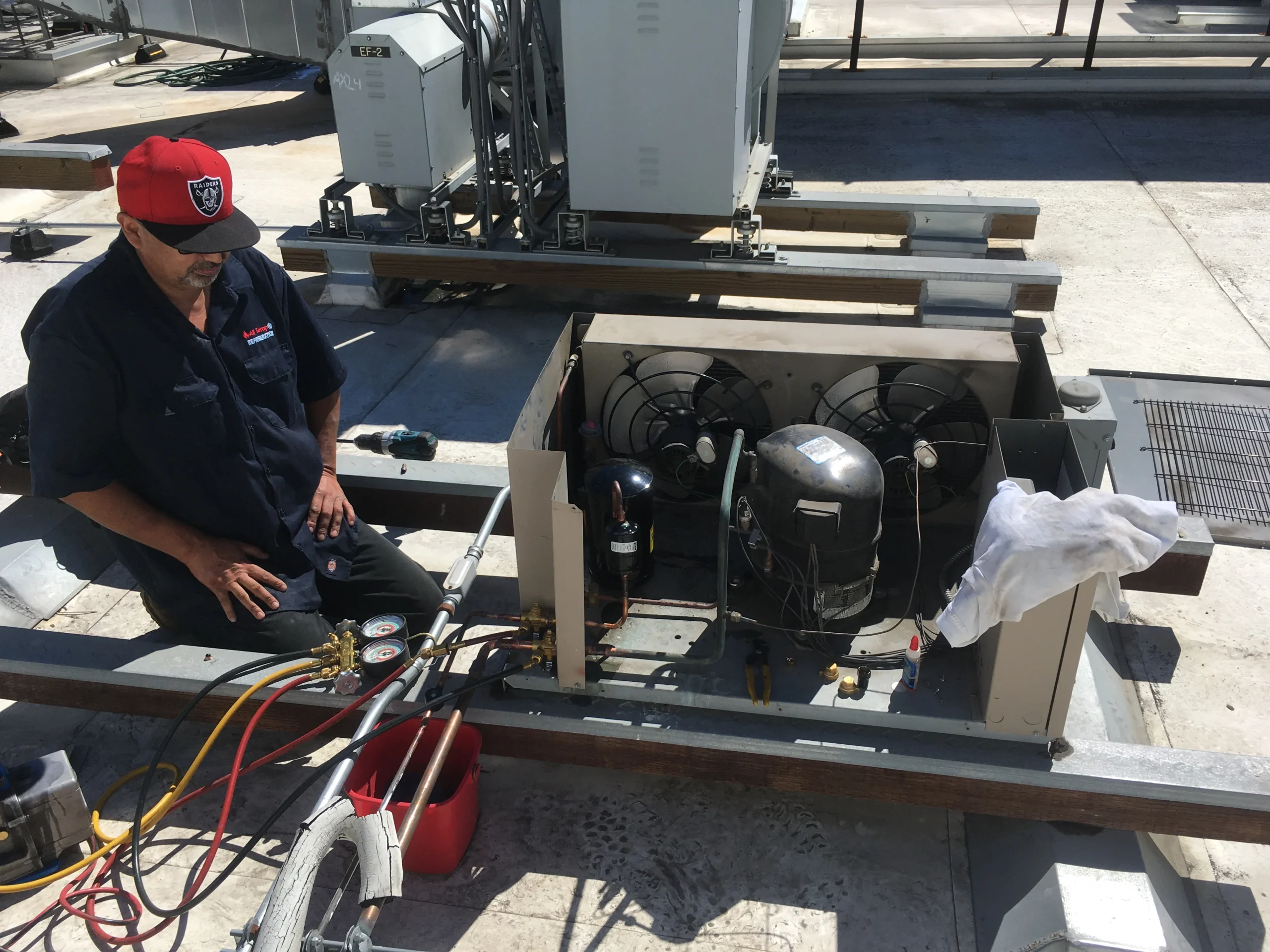
A certified technician will: – Measure refrigerant charge using manifold gauges – Check superheat and subcooling values against manufacturer specs – Inspect refrigerant lines for signs of oil stains (indicating a leak) – Repair any leaks and recharge to factory specifications
12. Electrical Connection and Capacitor Test
Electrical components are the #1 cause of AC no-start calls during Bay Area summer heat waves. Capacitors—the cylindrical components that help motors start—degrade over time and often fail when temperatures spike.
A technician will: – Tighten all electrical connections – Test the start and run capacitors with a multimeter – Check the contactor for pitting or burn marks – Verify the compressor amp draw is within manufacturer specifications – Inspect wiring for signs of heat damage or pest intrusion
13. Evaporator and Condenser Coil Cleaning
Even with a clean filter, your evaporator coil (indoor) and condenser coil (outdoor) accumulate grime over time. Dirty coils reduce heat transfer by up to 30%, which means your system runs longer and costs more.
A technician will: – Apply a commercial coil cleaner to both the evaporator and condenser coils – Rinse the condenser coil with a pressure-safe spray – Straighten any bent condenser fins using a fin comb – Check for corrosion, especially on units exposed to coastal Bay Area air
14. Full System Performance Test
This is the comprehensive health check that tells you whether your system is actually performing to spec—not just “running.”
A technician will: – Measure supply and return air temperature differential (should be 15–20°F) – Check airflow volume across the evaporator coil – Verify the blower motor speed settings are correct for cooling mode – Test the system through a full cooling cycle – Document findings and flag anything approaching end-of-life
If your system is showing signs of age, this test gives you data to make a repair-vs-replace decision before you’re stuck in the heat.
15. Duct Leakage Assessment
Bay Area homes lose an average of 20–30% of conditioned air through duct leaks—especially in homes with ductwork running through unconditioned attics. A duct leakage test identifies exactly where you’re losing air and how much.
A technician will: – Pressurize your duct system and measure leakage rates – Identify specific leak locations using smoke or pressure testing – Recommend sealing or repair options (mastic sealant, aerosol sealing, or duct replacement) – Calculate potential energy savings from sealing
AC Summer Checklist Bay Area: When to Start
The best time to run through this checklist is April or early May, before the first Bay Area heat wave. HVAC companies get slammed starting in late May, and by July, you could wait a week or more for a service appointment. Prepping your HVAC for Bay Area summer early means you’ll be cool and comfortable when your neighbors are sweating on hold.
FAQ: AC Summer Checklist Bay Area
How often should I change my AC filter during Bay Area summer?
During summer, replace standard 1-inch filters every 30–60 days. If you have pets, live in a wildfire-prone area, or have household members with allergies, check monthly and replace as needed. Higher-capacity 4-inch filters can last 3–6 months.
What temperature should I set my AC to during a Bay Area heat wave?
ENERGY STAR's programmable-thermostat guidance suggested about 78°F when you are home and a higher setting, such as 85°F, when you are away. During extreme heat events (100°F+), don’t set your thermostat more than 20 degrees below the outdoor temperature—this overworks the system. Close blinds on south- and west-facing windows to reduce solar heat gain.
How much does a professional AC tune-up cost in the Bay Area?
A standard AC tune-up in the Bay Area ranges from $89–$175, depending on the company and scope of the inspection. Some companies offer seasonal maintenance plans that include two tune-ups per year (spring and fall) for $150–$300 annually, often with priority scheduling and repair discounts.
Can I do AC maintenance myself or do I need a professional?
You can handle about two-thirds of seasonal AC maintenance yourself: filter changes, vent cleaning, debris clearing, thermostat testing, and condensate drain flushing. However, tasks involving refrigerant, electrical components, and coil cleaning require a licensed technician with specialized tools and EPA certification.
What’s the most common reason AC systems fail during Bay Area summers?
The top three causes of summer AC failure in the Bay Area are: (1) capacitor failure due to heat stress, (2) clogged condensate drain lines causing system shutoff, and (3) low refrigerant from undetected leaks. All three are preventable with a spring tune-up. That’s why we recommend scheduling your professional maintenance before the season starts.
Ready to Check Off Your AC Summer Checklist?
Don’t wait for the first 100-degree day to find out your AC isn’t ready. Cool Aid Air Conditioning & Refrigeration has been keeping Bay Area homes comfortable since 1966—and we’ve seen what happens when homeowners skip their spring checklist.
Schedule your pre-summer AC tune-up today or call us at 1-800-266-5243. We offer comprehensive seasonal tune-ups that cover all 5 professional checklist items in a single visit, with transparent pricing and no upsell pressure. Because the best AC repair is the one you never need.
Stay Comfortable Year-Round With Expert HVAC Service
Book a trusted technician to handle your heating or cooling issue—fast, professional, and done right the first time.
Book Service Now