Choosing between a rooftop HVAC vs split system commercial setup is one of the most consequential decisions a Bay Area building owner or property manager will make. The system you select affects installation cost, ongoing maintenance expenses, tenant comfort, available floor space, and even your building’s compliance with local Title 24 energy codes. Get it right and you’ll enjoy decades of reliable climate control; get it wrong and you’ll be writing checks for inefficiency and repairs for years to come.
In this guide, the Cool Aid Team breaks down every factor — from upfront pricing to long-term operating costs — so you can confidently choose the right commercial HVAC configuration for your building.
Quick Comparison: Rooftop HVAC vs Split System Commercial Overview
| Factor | Rooftop Unit (RTU) | Split System |
| Installation Cost | $5,000–$15,000 per ton | $4,000–$12,000 per ton |
| Best Building Types | Retail, warehouses, single-story offices | Multi-story offices, restaurants, mixed-use |
| Space Impact | Frees up all interior floor space | Requires indoor mechanical room or closet |
| Maintenance Access | Roof access required (crane/ladder) | Ground-level outdoor unit + indoor air handler |
| Average Lifespan | 15–20 years | 15–25 years |
| Noise (Interior) | Very low — equipment is on the roof | Moderate — indoor air handler produces some sound |
| Energy Efficiency (SEER2) | 14–18 SEER2 typical | 15–21 SEER2 typical |
| Scalability | Easy — add another rooftop unit | Moderate — may require additional refrigerant lines |
| Bay Area Code Compliance | Must meet Title 24 + local seismic bracing | Must meet Title 24 + refrigerant line-set rules |
What Is a Rooftop HVAC Unit?
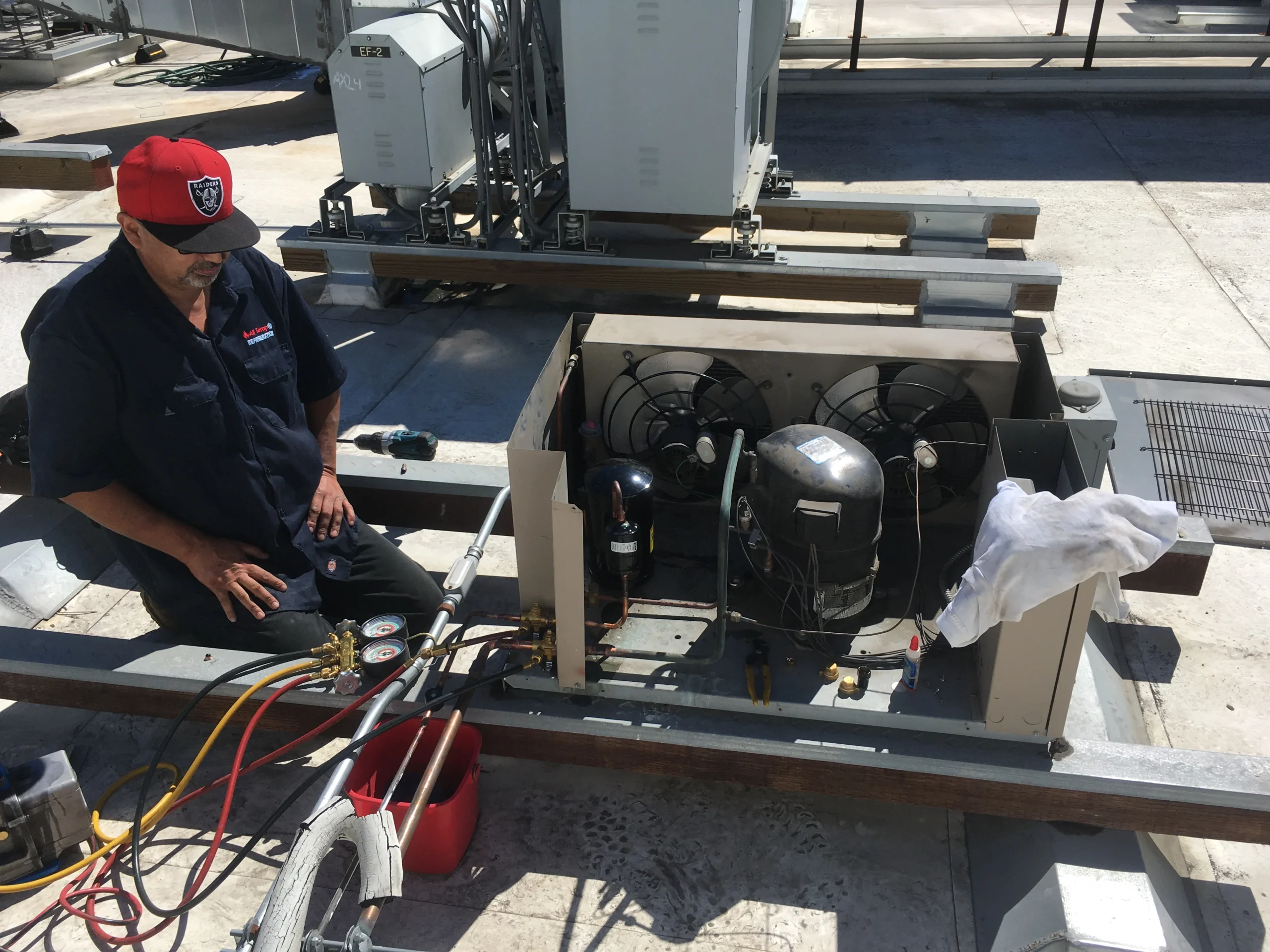
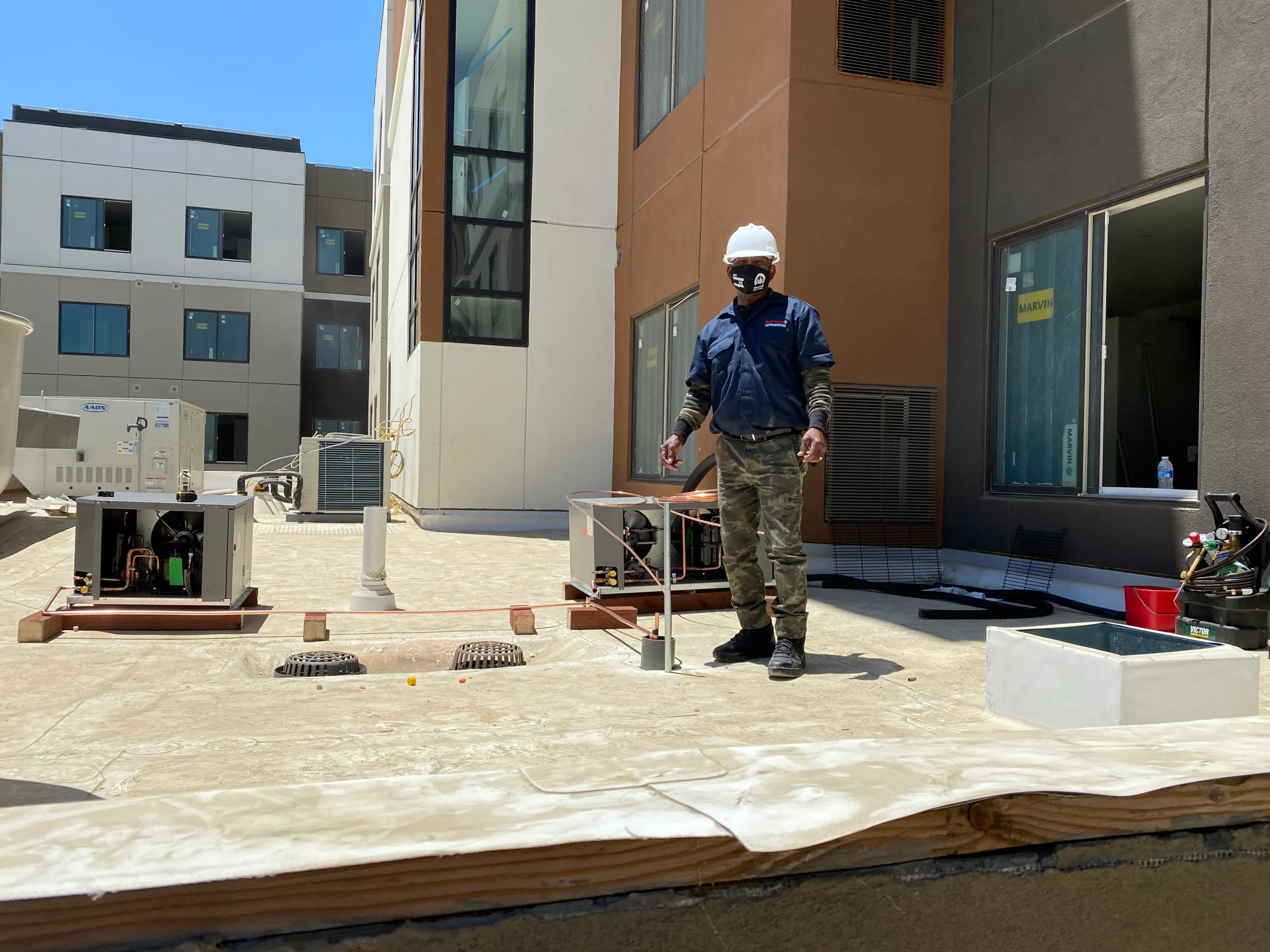
A rooftop unit (RTU) is a self-contained, packaged HVAC system installed on the roof of a commercial building. Every component — compressor, condenser, evaporator coil, blower, and controls — lives inside a single weatherproof cabinet. Conditioned air is delivered to the occupied space through a network of supply and return ducts.
Key Advantages of Rooftop HVAC
- Zero interior footprint. The entire system sits on the roof, freeing up valuable square footage for revenue-generating uses.
- Simplified installation. Because all components ship in one package, installation is faster and often less expensive on single-story structures.
- Easy zoning. Buildings can install multiple smaller RTUs, each serving a different zone, which simplifies temperature control for multi-tenant spaces.
- Equipment on the roof is less vulnerable to vandalism and accidental damage.
- Ideal for Bay Area retail and warehouse buildings. Single-story commercial strips, big-box stores, and industrial spaces across San Jose, Fremont, and Sunnyvale commonly use RTUs.
Drawbacks of Rooftop Units
- Roof access logistics. Technicians need ladder or crane access for every service call, which can increase maintenance costs.
- Weather exposure. Bay Area fog, salt air near the coast, and seasonal heat all accelerate wear on exposed rooftop equipment.
- Structural requirements. The roof must support the weight of the unit (often 400–2,000+ lbs), and Bay Area seismic codes require proper bracing and curb adapters.
- Shorter condenser lifespan. Constant sun and weather exposure can shorten condenser coil life compared to protected ground-level units.
For a deeper dive into packaged rooftop systems, see our Ultimate Rooftop HVAC Master Guide for the Bay Area.
What Is a Commercial Split System?
A split system separates the HVAC equipment into two main components: an outdoor condensing unit (installed at ground level or on a rooftop equipment pad) and an indoor air handler or furnace. Refrigerant lines connect the two. In commercial applications, split systems range from single-zone wall-mounted units to large multi-zone variable refrigerant flow (VRF) systems.
Key Advantages of Split Systems
- Higher peak efficiency. Commercial split systems are available in SEER2 ratings up to 21+, which can substantially lower PG&E operating costs.
- Quieter operation for occupants near the outdoor unit. The loudest component (the compressor) is outside, and high-end inverter-driven models are whisper-quiet.
- Easier maintenance access. Ground-level outdoor units don’t require a ladder, crane, or rooftop safety harness — reducing technician labor time and cost.
- Flexible placement. The outdoor condenser can go on a concrete pad, a balcony, or a small rooftop section without dominating the entire roof.
- Better fit for multi-story buildings. Air handlers on each floor keep duct runs short, which improves efficiency and comfort.
Drawbacks of Split Systems
- Interior space requirement. The indoor air handler or furnace needs a mechanical closet, utility room, or ceiling plenum — eating into usable square footage.
- Refrigerant line routing. Long line sets between indoor and outdoor units add installation cost and introduce potential leak points.
- More complex installation. Coordinating two separate equipment locations, running line sets through walls or ceilings, and managing condensate drainage adds labor hours.
Rooftop HVAC vs Split System Commercial: Installation Cost Breakdown
Installation cost is often the deciding factor. Here’s what Bay Area commercial property owners can expect in 2025–2026:
Rooftop Unit Installation Costs
| Building Size | RTU Tonnage | Estimated Cost (Installed) |
| Small retail (1,500–3,000 sq ft) | 5–7.5 tons | $12,000–$25,000 |
| Medium office (3,000–8,000 sq ft) | 7.5–15 tons | $22,000–$50,000 |
| Large warehouse (10,000–25,000 sq ft) | 20–40 tons (multiple units) | $55,000–$150,000+ |
Crane rental for hoisting units to the roof typically adds $1,500–$5,000 per lift in the Bay Area. Structural engineering and seismic bracing can add another $2,000–$8,000.
Split System Installation Costs
| Building Size | System Size | Estimated Cost (Installed) |
| Small restaurant/office (1,500–3,000 sq ft) | 5–7.5 tons | $10,000–$22,000 |
| Medium office (3,000–8,000 sq ft) | 7.5–15 tons | $20,000–$45,000 |
| Multi-story office (10,000–25,000 sq ft) | Multiple zones | $50,000–$140,000+ |
Split systems save on crane costs but may require more indoor labor for air handler installation, ductwork modifications, and refrigerant line routing.
For a personalized quote, Cool Aid’s team provides free on-site assessments for Bay Area commercial properties. Learn more about our commercial HVAC installation services.
Maintenance Access and Long-Term Service Costs
Over a 15–20-year system lifespan, maintenance costs often exceed the original installation price. Accessibility plays a huge role in how much you’ll spend.
Rooftop HVAC Maintenance Considerations
- Seasonal filter changes, coil cleaning, and belt inspections require roof access every visit.
- Bay Area coastal fog and summer dust accelerate condenser coil fouling — expect coil cleaning 2–3 times per year.
- Roof warranty conflicts. Poorly planned rooftop work can void roofing warranties. Always use an HVAC contractor who coordinates with your roofer.
- Average annual maintenance cost: $1,200–$3,500 per unit, depending on tonnage and service plan.
Split System Maintenance Considerations
- Ground-level condenser service is faster and cheaper — technicians don’t bill for roof access time.
- Indoor air handler maintenance (filter changes, coil cleaning, drain pan flushing) requires access to the mechanical closet.
- Refrigerant leak detection is more complex with long line sets running through walls.
- Average annual maintenance cost: $800–$2,800 per system.
Cool Aid offers customizable commercial HVAC maintenance programs that cover both rooftop and split system equipment with priority scheduling and transparent pricing.
Space Considerations for Bay Area Commercial Buildings
Bay Area commercial real estate is expensive — every square foot matters.
When a Rooftop HVAC vs Split System Commercial Choice Saves Space
Rooftop units win on interior space. A 10-ton RTU that would otherwise require a 60-square-foot mechanical room sits entirely on the roof. At Bay Area lease rates of $3–$6 per square foot per month, that freed-up space could be worth $2,160–$4,320 per year in revenue.
Split systems win on roof space. If your building’s roof is already crowded with solar panels, satellite equipment, or outdoor dining structures, a split system’s smaller outdoor condenser takes up far less rooftop real estate.
Ideal Building Types for Each System
| Building Type | Recommended System | Why |
| Single-story retail strip | Rooftop unit | Flat roof, easy crane access, maximizes selling floor |
| Multi-story office | Split system | Air handlers on each floor shorten duct runs |
| Restaurant | Split system or small RTU | Kitchen exhaust complicates rooftop layouts; splits offer flexibility |
| Warehouse / industrial | Rooftop unit | Large flat roof, minimal interior HVAC footprint needed |
| Mixed-use (retail + residential above) | Split system (VRF) | Individual zone control per unit, no large rooftop footprint |
| Medical / dental office | Split system | Precise zone control, quieter operation for patient comfort |
Bay Area Code Requirements for Rooftop vs Split Systems
Every commercial HVAC installation in the Bay Area must comply with:
- California Title 24 Part 6 (Energy Code). Minimum efficiency standards, mandatory economizers on systems 4.5 tons and above, and demand-controlled ventilation requirements.
- Title 24 Part 11 (CALGreen). Refrigerant leak-reduction measures for new commercial refrigeration systems in larger retail food stores.
- Local seismic bracing codes. The Bay Area sits on active fault lines, so rooftop units must be seismically anchored under CBC Section 1613 and ASCE 7 Chapter 13.
- Bay Area Air Quality Management District (BAAQMD). NOx emission rules for gas-fired furnaces, boilers and water heaters.
- Local building department permits. San Jose, San Francisco, Fremont, Palo Alto, and other Bay Area cities each have specific mechanical permit requirements.
Key difference: Rooftop units face stricter seismic and structural requirements because of their elevated position, while split systems with long line sets must comply with more detailed refrigerant piping codes. Both require Title 24 verification: HERS (ECC-Rater) testing for residential systems and acceptance testing for commercial systems.
Cool Aid’s C-20 licensed technicians handle permitting, code compliance, and inspections for both system types across the entire Bay Area. See our full range of commercial HVAC services.
Which System Is Right for Your Building? Our Recommendation
There’s no universal answer — the best system depends on your building’s structure, your budget, and your operational priorities.
Choose a rooftop HVAC unit if: – You have a single-story building with a flat roof in good condition – Interior square footage is at a premium – You want straightforward zoning with independent units per zone – Your roof can handle the structural and seismic requirements
Choose a split system if: – Your building is multi-story – Ground-level maintenance access is important to you – You want the highest possible efficiency ratings to lower PG&E bills – Your roof is already occupied by solar panels, equipment, or has weight limitations
Consider a hybrid approach for larger commercial properties: rooftop units for common areas and split or VRF systems for individual tenant suites. Cool Aid designs and installs hybrid configurations regularly for Bay Area office parks and mixed-use developments.
Frequently Asked Questions
How long does a rooftop HVAC unit last vs a split system?
Rooftop units typically last 15–20 years with proper maintenance, while split systems can last 15–25 years. The difference often comes down to weather exposure — rooftop units endure more sun, rain, and temperature swings, which can shorten component life. Regular preventive maintenance extends the lifespan of both system types significantly.
Is a rooftop unit or split system more energy-efficient?
Split systems generally offer higher peak efficiency ratings (up to 21+ SEER2) compared to packaged rooftop units (typically 14–18 SEER2). However, real-world efficiency depends on installation quality, duct design, and maintenance. A well-maintained RTU with an economizer can outperform a poorly installed split system.
Can I switch from a rooftop unit to a split system (or vice versa)?
Yes, but it involves significant work. Switching from an RTU to a split system requires installing indoor air handlers, routing refrigerant lines, and potentially modifying ductwork. The reverse involves rooftop structural assessment, crane work, and curb adapter installation. Budget $15,000–$50,000+ for a system-type conversion depending on building size.
Do Bay Area rooftop HVAC units need special seismic bracing?
Absolutely. California Building Code requires seismic restraint for all rooftop mechanical equipment. In the Bay Area, which sits near multiple active fault lines, this is strictly enforced. Proper seismic bracing includes spring isolators, snubbers, and equipment tie-downs that meet ASCE 7 standards. Failure to comply can result in permit rejection and insurance issues.
How often should commercial HVAC systems be serviced in the Bay Area?
Most commercial systems should receive professional maintenance at least twice a year — once before cooling season (spring) and once before heating season (fall). Rooftop units in coastal Bay Area locations may need quarterly coil cleaning due to salt air and fog exposure. Cool Aid’s commercial maintenance plans are customized to your system type and location.
Ready to Choose the Right System for Your Building?
Whether you’re installing a new rooftop unit, upgrading to a high-efficiency split system, or need expert guidance on the best approach for your commercial property, Cool Aid Air Conditioning & Refrigeration has been helping Bay Area businesses make smart HVAC decisions since 1966.
📞 Call us at 1-800-266-5243 or request a free commercial consultation to discuss your building’s specific needs with our C-20 licensed team.
Stay Comfortable Year-Round With Expert HVAC Service
Book a trusted technician to handle your heating or cooling issue—fast, professional, and done right the first time.
Book Service Now