
You’re sitting on the couch, and the air conditioner kicks on. You feel a brief burst of cool air, and then, three minutes later, silence. Five minutes pass, and it roars to life again, only to shut off moments later. This start-stop, start-stop rhythm isn’t just annoying noise; it’s a specific and serious mechanical behavior called “short cycling.”
When your HVAC system short cycles, it is failing to complete a full cooling or heating cycle. Instead of running steadily to reach the temperature set on your thermostat, it gets interrupted. This is one of the most stressful things your equipment can endure.
At Cool Aid A/C & Refrigeration, we diagnose short cycling issues regularly. It’s rarely a “ghost in the machine.” It’s almost always a clear signal that something—airflow, pressure, electrical signals, or sizing—is out of balance. Ignoring it is the fastest way to turn a repairable issue into a dead compressor.
What HVAC Short Cycling Looks Like in Real Homes
Short cycling is often misunderstood as the system just “working hard” on a hot day. But there is a distinct difference between a system running frequently because it’s 100 degrees outside and a system short cycling.
In a normal scenario, your AC or furnace turns on, runs for a sustained period (usually 15 to 20 minutes), satisfies the thermostat, and then shuts off for a while. With short cycling, the “on” time is drastically cut short. The system might run for fewer than five minutes before shutting down. Then, because the room hasn’t actually cooled down or warmed up enough, the thermostat calls for it to turn on again almost immediately.
Why short cycling feels different from normal operation
You will notice the difference in comfort. Because the system never runs long enough to dehumidify the air (in summer) or evenly distribute heat (in winter), your home feels clammy or has distinct hot and cold spots. You might also notice the lights in your house flickering more often because the HVAC unit is constantly pulling that massive surge of startup power. If you feel like your system is “hiccuping” rather than running, that is short cycling.
Why Short Cycling Is One of the Most Damaging HVAC Problems
If you wanted to destroy an electric motor as fast as possible, you would turn it on and off repeatedly without letting it run. That is exactly what short cycling does to your expensive HVAC components.
The most stressful moment for an air conditioner or heat pump is the startup. The compressor requires a huge jolt of electricity—locked rotor amperage (LRA)—to overcome inertia and get moving. This generates heat and mechanical stress. Under normal conditions, the system runs long enough for the refrigerant to flow, the oil to circulate, and the motor to cool itself down with the refrigerant gas.
How frequent starts stress compressors and motors
When a system short cycles, the compressor gets hit with that startup stress over and over, but it never runs long enough to dissipate the heat or lubricate itself properly. The windings inside the motor start to overheat. The start capacitor takes a beating from the constant electrical surges. Eventually, something gives. Usually, it’s the compressor—the heart of your system and the most expensive part to replace.
Normal Cycling vs. Short Cycling: How to Tell the Difference
Homeowners often ask us, “How long should my AC run?” The answer varies based on the weather, your insulation, and the age of the home, but there are general benchmarks for healthy operation.
What proper run times should look like
On a mild day, a properly sized and functioning system might run two or three times an hour, staying on for 10 to 15 minutes at a time. On an extremely hot Bay Area afternoon, it might run for 30 minutes or even continuously to keep up with the heat load. This is healthy. Continuous running on a peak heat day is actually better for the equipment than cycling on and off.
If your system is turning on 6, 8, or 10 times an hour, or if it runs for 3 minutes and shuts off for 3 minutes, that is not normal cycling. That is a malfunction.
Thermostat Problems That Cause HVAC Cycling Issues
Before we tear apart the outdoor unit, we always look at the brain of the operation: the thermostat. If the thermostat is sending confused signals, the equipment will behave erratically.
Bad placement, wiring faults, and miscalibration
Location matters. If your thermostat is installed on a wall that gets hit by direct sunlight in the afternoon, or if it’s located right near a supply vent, it will get a false reading. The sun hits the plastic case, the thermostat thinks it’s 85 degrees, and it turns on the AC. Two minutes later, a cloud passes or the vent blows cold air right onto it, the thermostat thinks it’s 70 degrees, and shuts off. This “ghost” temperature swing causes rapid cycling.
Loose wiring behind the faceplate can also cause the 24-volt control signal to drop in and out. If the “Y” wire (cooling) makes intermittent contact due to vibration, the outdoor unit will start and stop rapidly, mimicking a mechanical failure.
Airflow Restrictions That Trigger Early Shutdowns
Your HVAC system relies on a constant volume of air moving over the coils to transfer heat. If that airflow stops or slows down, the system temperatures go haywire, triggering safety switches that shut everything down to prevent damage.
Dirty filters, blocked returns, and undersized ducts
The most common culprit is a dirty air filter. If the filter is clogged, the blower motor can’t push air through the furnace or air handler.
- In Heating Mode: The lack of airflow causes the heat exchanger to get dangerously hot. The “high limit switch” detects this and kills the burners immediately. The fan runs to cool it down, the burners re-ignite, and the cycle repeats.
- In Cooling Mode: Restricted airflow causes the evaporator coil to get too cold, potentially freezing up. Some modern systems have freeze protection sensors that will cut the cycle short if coil temperatures drop too low.
Blocked return vents (by furniture or rugs) or ductwork that is too small for the size of the system creates the same effect. The system is essentially suffocating, and it shuts down to save itself.
Oversized HVAC Systems That Cycle Too Fast
Bigger is not always better. In fact, in the HVAC world, bigger is often disastrous. If a contractor installed a 5-ton unit for a home that only needs a 3-ton unit, you are going to have permanent short cycling issues.
Why bigger systems reach set temperature too quickly
An oversized unit is like using a firehose to fill a water glass. It blasts the house with a huge amount of cold air, dropping the temperature from 78 to 72 in four minutes flat. The thermostat is satisfied, so it shuts the unit off. But the walls, furniture, and humidity in the air haven’t actually cooled down yet. As soon as the unit stops, the heat from the structure radiates back out, the thermostat rises, and the unit kicks on again.
This “blast and stop” pattern destroys efficiency. It also leaves the house feeling humid and sticky because the air conditioner needs long run times to effectively remove moisture from the air.
Refrigerant and Pressure Issues That Cause HVAC Short Cycling
Refrigerant leaks or blockages create pressure problems inside the sealed system. Your HVAC unit is equipped with safety devices—specifically low-pressure and high-pressure switches—that constantly monitor these levels.
How pressure imbalances trip safety limits
- Low Pressure Switch: If you have a refrigerant leak, the pressure on the suction side drops. The low-pressure switch detects this and cuts power to the compressor to prevent it from sucking in air or running without lubrication. The pressures equalize slightly while it’s off, allowing it to start again, only to trip the switch moments later.
- High Pressure Switch: If your outdoor coil is dirty or the fan motor fails, the system can’t release heat. The pressure on the discharge side skyrockets. The high-pressure switch kills the system to prevent the compressor from exploding or the pipes from bursting.
If your system is short cycling due to a pressure switch, it is screaming for help. Resetting the breaker won’t fix it; you need a professional to find the leak or clear the blockage.
Electrical Components That Fail and Cause Rapid Cycling
Sometimes the signal to run is there, but the electrical components that do the heavy lifting are failing.
Capacitors, contactors, and control boards under stress
- Failing Capacitor: The run capacitor stores energy to keep the compressor and fan motors running smoothly. If it is weak or bulging, the motor might start, struggle to maintain torque, overheat, and shut itself off on thermal overload. It cools down, clicks back on, and repeats the cycle.
- Pitted Contactor: The contactor is the heavy-duty switch that pulls in to send power to the outdoor unit. Over time, the metal contacts get pitted and charred from electrical arcing. This creates a poor connection that can chatter or drop voltage, causing the compressor to stumble and shut off erratically.
- Control Board Glitches: The main circuit board in your furnace or air handler manages the timing of all operations. If a relay on the board sticks or fails, it might cut power to the outdoor unit randomly, causing short cycling.
Why HVAC Short Cycling Drives Up Energy Bills
We mentioned earlier that short cycling damages equipment, but it also damages your bank account. You might think that because the unit is running for shorter periods, it’s using less electricity. The opposite is true.
High startup power draw vs. steady operation
An air conditioner running steadily at cruising speed is relatively efficient. An air conditioner starting up is an energy hog. It takes 5 to 8 times more energy to start an AC motor than to keep it running.
If your system starts 10 times an hour instead of 2, you are paying for that expensive startup surge 8 extra times every hour. You are essentially paying premium pricing for the worst possible performance. This is why short cycling is often accompanied by a shocking utility bill.
How Short Cycling Leads to Repeat HVAC Repairs
Short cycling is rarely a “one-and-done” repair scenario if the root cause isn’t found. We often visit homes where a previous technician just replaced a blown capacitor or a burnt wire, only for the system to fail again two weeks later.
Why replacing parts without fixing the cause doesn’t work
If the capacitor blew because the system is short cycling due to a dirty coil, replacing the capacitor is just a band-aid. The new capacitor will blow, too, because the underlying stress (high head pressure from the dirty coil) is still there.
Short cycling creates a vibration and heat environment that loosens wires, cracks braze joints, and wears out bearings. Until the cycle is stabilized, you will be stuck in a loop of replacing secondary parts while the primary problem continues to eat away at your system’s lifespan.
What Homeowners Can Safely Check When HVAC Cycling Starts
If you notice the dreaded start-stop pattern, shut the system off at the thermostat. Letting it bang on and off while you wait for a technician will only cause more damage. Once it’s off, there are a few things you can check.
Simple checks that don’t require tools or risk
- Check the Air Filter: This is the #1 cause of short cycling in heating mode (furnaces). If it’s grey and matted, replace it immediately.
- Check the Thermostat: Is it located near a heat source like a lamp or TV? Is a supply vent blowing directly on it?
- Inspect the Outdoor Unit: Is the coil wrapped in a “blanket” of dryer lint, dog hair, or leaves? If so, airflow is blocked. (Note: Only clean this with water if you know how to do so safely without bending the fins; otherwise, leave it to a pro).
- Check Vents: Ensure at least 80% of your home’s vents are open. Closing too many vents increases static pressure and can choke the system.
How Professionals Diagnose HVAC Short Cycling
When a Cool Aid technician arrives, we don’t guess. We hook up diagnostic tools that let us see what the system is doing in real-time.
Static pressure, amperage, and control signal testing
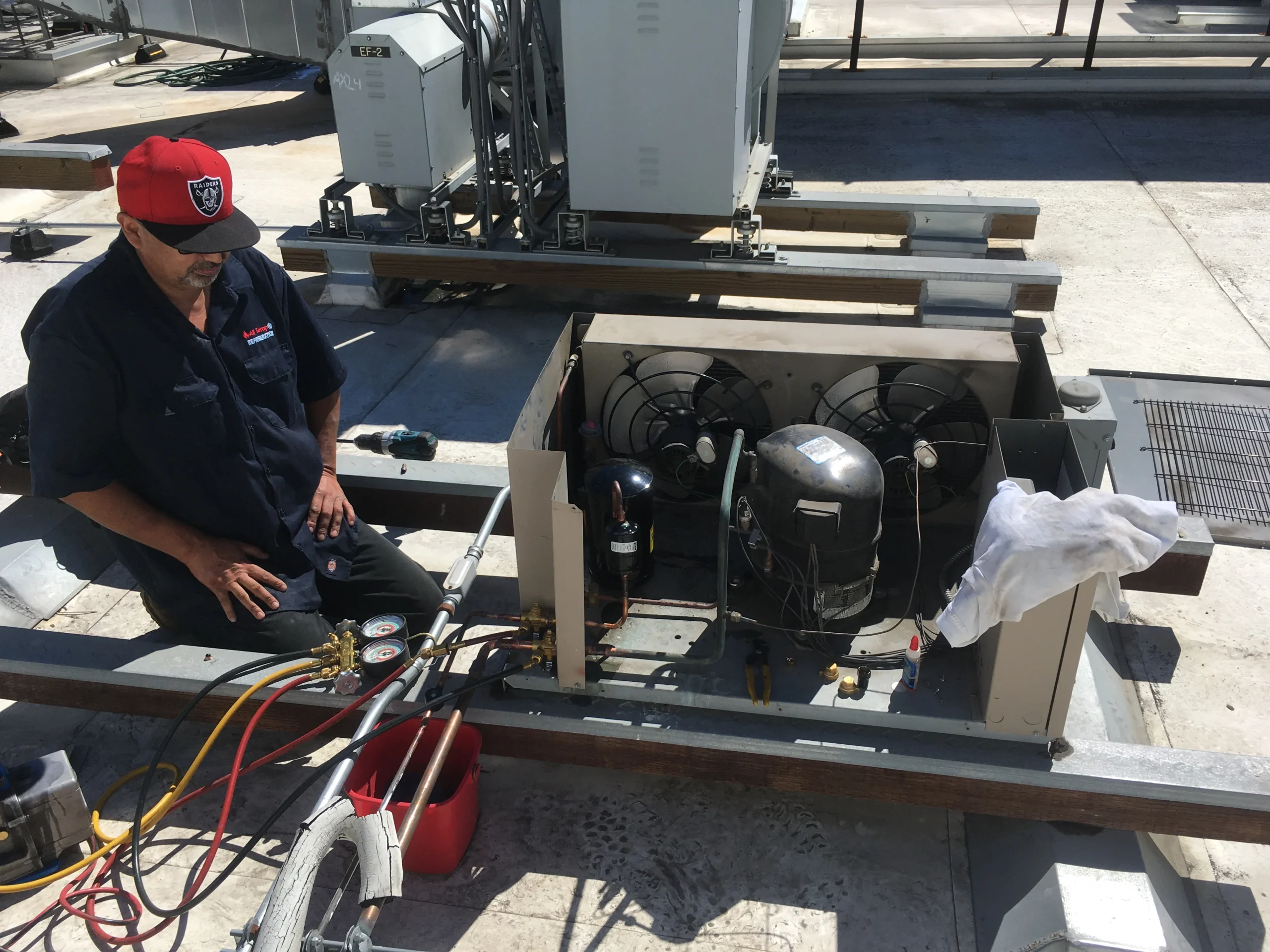
- Gauge Manifold: We watch the refrigerant pressures as the system starts. A fluttering needle or a rapid drop tells us exactly which safety switch is tripping.
- Multimeter: We clamp an amp meter onto the compressor wire. If we see the amperage climb steadily until the unit shuts off, we know the compressor is mechanically tight or overheating.
- Thermostat Wire Trace: We verify that the thermostat is sending a solid, steady 24 volts. If the voltage drops out, we know the issue is in the controls, not the refrigerant.
- Static Pressure: We measure the resistance in the ductwork. This confirms if the short cycling is due to undersized ducts or a blockage.
If Your HVAC System Won’t Stay Running Long Enough
Short cycling is a cry for help. It’s your HVAC system telling you that it cannot operate safely under the current conditions. Every time it shuts down early, it’s saving itself from catastrophic failure—but it can only do that for so long.
At Cool Aid A/C & Refrigeration, we understand the physics behind short cycling. We don’t just swap parts; we look for the airflow restrictions, the electrical faults, or the design flaws that are causing the behavior. Our goal is to smooth out the operation, lower your energy bills, and stop the wear and tear before it costs you a compressor.
If your AC or furnace is caught in a start-stop loop, don’t ignore it. Contact us today to stabilize your system and restore reliable comfort.
Stay Comfortable Year-Round With Expert HVAC Service
Book a trusted technician to handle your heating or cooling issue—fast, professional, and done right the first time.
Book Service Now