Heat pumps don’t fail loudly. Most of the time, they just stop keeping up. The house feels off, the air isn’t quite right, and the system seems to be working without actually doing its job. In winter, the air feels cooler than it should. In summer, it runs longer but never really catches up.
That confusion is common with heat pumps because they’re doing two jobs at once. Heating and cooling rely on the same components, just running in opposite directions. When something goes wrong, the symptoms don’t always point clearly to the cause. What looks like a heating issue may actually be a cooling problem showing up in a different season.
Winter help: heat pump problems in winter.
At Cool Aid A/C & Refrigeration, we see this all the time. Homeowners know something isn’t right, but the system hasn’t completely failed, so it’s hard to tell what matters and what doesn’t. The key isn’t guessing—it’s understanding how technicians diagnose heat pump problems, what we test first, and how one small failure can affect the entire system.
Why Heat Pumps Fail Differently Than Traditional HVAC Systems
A heat pump isn’t just an air conditioner that can also run in reverse. It’s a sophisticated system that uses a special component called a reversing valve to change the direction of refrigerant flow. In the summer, it absorbs heat from inside your home and moves it outside. In the winter, it reverses the process, absorbing heat from the outdoor air (even when it’s cold) and moving it inside.
What makes heat pump problems harder to spot
This dual function is what makes diagnosing them tricky. A single component failure—like a weak capacitor or a refrigerant leak—can manifest differently depending on the season. A problem that causes weak cooling in the summer might cause a total loss of heat in the winter. A homeowner might think they have two separate problems, when in reality, it’s one underlying issue affecting both modes of operation. That’s why a systematic, diagnostic approach is critical.
Common Heat Pump Problems Homeowners Notice First
Before a heat pump quits entirely, it will almost always show signs of distress. These are the two most common complaints we hear from homeowners.
Weak heating or cooling output
This is the most frequent symptom. In the summer, the air coming from your vents just isn’t very cold. In the winter, it feels lukewarm or even cool to the touch. The system runs, but it can’t keep up with the outdoor temperature, and the house never feels truly comfortable. This points to a problem with the heat transfer process itself.
Heat pump running constantly or cycling too often
A healthy heat pump should run in cycles, turning on to meet the thermostat’s set temperature and then shutting off. If your system runs nonstop, it means it’s struggling to do its job. On the other hand, if it turns on and off every few minutes (short cycling), it often means a safety sensor is detecting a problem and shutting the system down prematurely.
Problem #1: Refrigerant and Pressure Imbalances
The refrigerant in your heat pump is the key to its ability to move heat. The system is factory-charged with a precise amount of refrigerant, and it operates in a sealed loop. If that charge is off, the entire system’s performance suffers.
Why low refrigerant affects both heating and cooling
If your system is low on refrigerant, it means there is a leak. In cooling mode, low refrigerant will cause weak cooling and can lead to the indoor coil freezing up. In heating mode, the effect is even more pronounced. The system will struggle to absorb heat from the cold outdoor air, resulting in lukewarm air blowing from your vents and a much higher reliance on expensive backup electric heat strips.
Problem #2: Defrost Cycle and Sensor Failures
During the winter, the outdoor coil of a heat pump gets very cold as it absorbs heat. It’s normal for a thin layer of frost to form on it. To handle this, heat pumps are designed with an automatic defrost cycle. Periodically, the system will switch back to cooling mode for a few minutes to warm up the outdoor coil and melt the frost.
When ice buildup points to control or airflow issues
If you see a thick layer of ice encasing your outdoor unit, the defrost cycle is failing. This is not a refrigerant issue; it’s a control problem. It could be a bad defrost control board, a faulty outdoor temperature sensor, or restricted airflow across the outdoor coil. When the unit is a block of ice, it can’t absorb any heat from the air, and your heating capacity drops to zero.
Problem #3: Reversing Valve Malfunctions
The reversing valve is the component that directs the flow of refrigerant, switching the system between heating and cooling. It’s a complex part with small internal passages and a solenoid that controls its position.
How technicians confirm a reversing valve failure
When a reversing valve fails, it usually gets stuck in one position. You might find your heat pump is stuck in heat mode during the summer or stuck in cool mode during the winter. A technician can diagnose this by checking the voltage at the solenoid and measuring the temperature on the different refrigerant lines coming off the valve. If the valve isn’t shifting when it’s commanded to, we know it needs to be replaced—a repair that involves recovering the system’s refrigerant charge.
Problem #4: Electrical and Control Board Issues
Like any HVAC system, a heat pump relies on a series of electrical components to run. This includes capacitors to start the motors, contactors to switch high-voltage power, and a central control board that acts as the system’s brain.
Why intermittent power causes unpredictable behavior
Electrical problems are often the cause of the most frustrating, intermittent issues. A failing capacitor might cause the outdoor fan to stop spinning intermittently, leading to overheating. A bad connection on the control board might cause the whole system to shut down randomly and then restart an hour later. These “ghost” problems can be hard to track down and require a technician to meticulously test the electrical pathway from the thermostat to the outdoor unit.
Problem #5: Airflow and Duct-Related Heat Pump Issues
A heat pump is only as good as the ductwork it’s connected to. It is designed to move a specific amount of air. If your ducts are leaky, undersized, or if your filter is clogged, the system cannot perform to its specifications.
How restricted airflow mimics mechanical failure
Poor airflow can create symptoms that look exactly like a refrigerant or compressor problem. A clogged filter can cause the system to overheat in heating mode or freeze up in cooling mode. Leaky return ducts pulling in unconditioned air from an attic or crawlspace will drastically reduce the system’s capacity. Before we ever suspect a major mechanical failure, we first confirm that the system can breathe properly.
How Technicians Diagnose Heat Pump Problems Step by Step
When a Cool Aid technician approaches a struggling heat pump, we don’t start by looking for broken parts. We start by gathering data with a methodical, step-by-step diagnostic process.
Testing pressure, voltage, sensors, and controls
- Homeowner Interview: We start by asking you what you’re experiencing. When did it start? Is it happening in heat, cool, or both?
- Static Inspection: We check the basics—air filter, vent obstructions, and the condition of the outdoor unit.
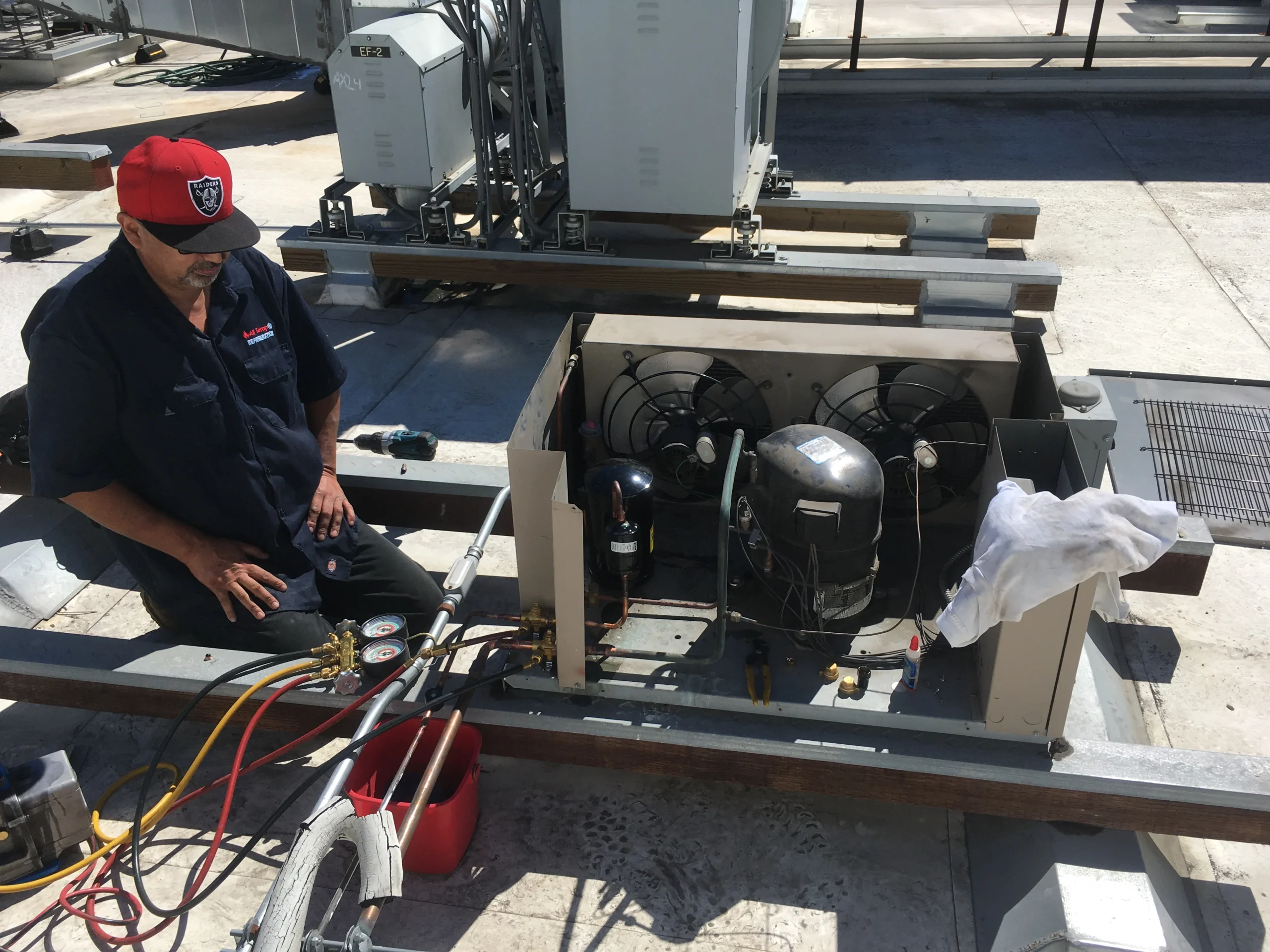
- Systematic Testing: We connect our gauges and meters to test the system in the mode it’s failing in. We check refrigerant pressures (superheat and subcooling), test voltage at all key components, measure the amperage draw of motors, and check the resistance of temperature sensors.
This process allows the data to lead us to the problem. We don’t guess; we measure, analyze, and confirm.
Why Guesswork Leads to Repeat Heat Pump Repairs
Because heat pump symptoms can be so misleading, guesswork is a recipe for disaster. An inexperienced technician might see a frozen coil and immediately assume the system is low on refrigerant. They might add more refrigerant without finding a leak, which overcharges the system and puts immense stress on the compressor.
How partial fixes miss the real problem
This “part-swapping” approach leads to repeat repairs. A technician might replace a failed control board without realizing that a short in the wiring is what damaged it in the first place, meaning the new board is destined to fail, too. A complete diagnosis ensures we fix both the failed part and the underlying reason for its failure. That is the difference between a temporary patch and a lasting repair.
Heat Pump Repair vs Replacement: What Factors Matter Most
If you’re facing a significant repair, like a compressor or reversing valve replacement, you’ll need to decide whether to repair or replace the unit. The right answer depends on a few key factors.
System age, efficiency, and repair history
- Age: If your heat pump is less than 10 years old, a repair usually makes financial sense. If it’s over 15 years old, investing thousands in a major repair may not be wise.
- Efficiency: Older heat pumps are far less efficient than modern units. The energy savings from a new, high-efficiency system can often help offset the installation cost over time.
- Repair History: If this is the first major repair on an otherwise reliable system, a fix is reasonable. If you’ve already had multiple service calls in the last couple of years, it might be time to stop throwing good money after bad.
If Your Heat Pump Isn’t Heating or Cooling the Way It Should
A heat pump that isn’t performing correctly is a complex problem, but it’s not a mystery. It’s a puzzle that can be solved with the right tools and a systematic approach. By understanding that a single issue can affect both heating and cooling, you can see why a thorough, professional diagnosis is so important.
At Cool Aid A/C & Refrigeration, our technicians are trained to look at your heat pump as a complete system. We take the time to gather the data needed to make an accurate diagnosis, so we can provide a repair that lasts. We give you straight answers and clear options, not guesswork.
If your heat pump is struggling, you don’t have to live with poor comfort. Contact us. Our team can find the root cause and get your system back to providing efficient heating and cooling for your home.
Stay Comfortable Year-Round With Expert HVAC Service
Book a trusted technician to handle your heating or cooling issue—fast, professional, and done right the first time.
Book Service Now