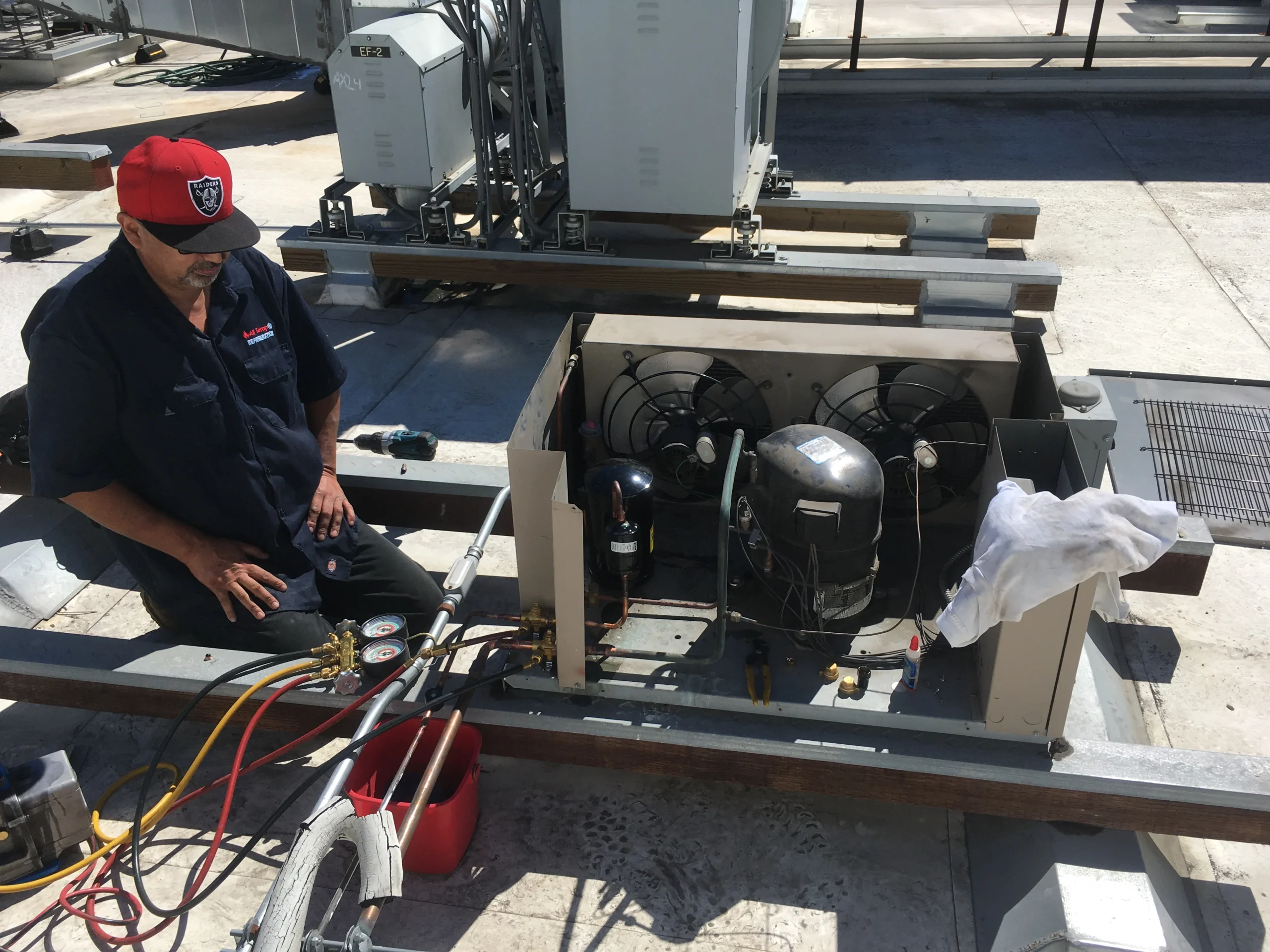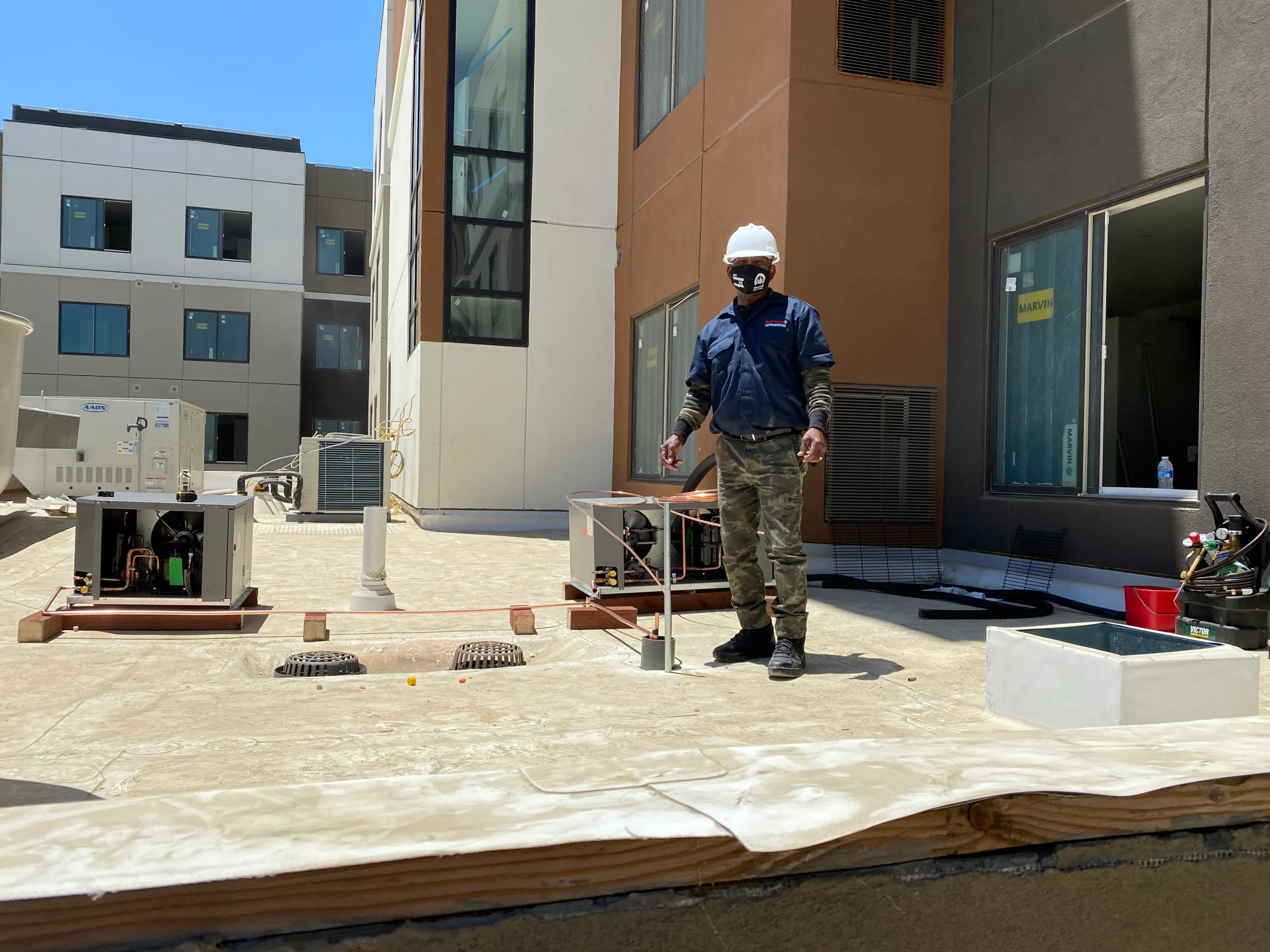

If your AC isn’t keeping up, it’s tempting to think it just needs a little more refrigerant and everything will be fine. That idea costs homeowners thousands every year. Refrigerant doesn’t disappear on its own. If levels are low, it escaped—and that means something in the system is failing.
We see it all the time across the Bay Area: systems getting topped off again and again while the real problem keeps getting worse. Meanwhile, the compressor runs hotter, energy bills climb, and a repair that could’ve been manageable turns into a major breakdown. That’s why leak detection matters. Not later. Not after the next refill. Right now.
Refrigeration help: refrigerant rules for businesses.
At Cool Aid A/C & Refrigeration, we don’t guess and we don’t sell band-aids. We track down where refrigerant is leaving the system, explain what that means for the equipment, and fix the problem at the source. That’s how you protect your system, your comfort, and your budget.
Why Refrigerant Leaks Are a Bigger Problem Than You Think
A small hiss of escaping refrigerant might seem minor, but it sets off a chain reaction that can destroy the most expensive parts of your HVAC system.
Refrigerant doesn’t “run out” — leaks are the only cause
Your air conditioner or heat pump is charged with a precise amount of refrigerant at the factory. This refrigerant is meant to stay sealed within the system’s copper coils and lines for its entire lifespan. It doesn’t evaporate or get consumed. If the level is low, it has physically escaped through a hole or a crack somewhere in the system.
How even small leaks lead to big system damage
The refrigerant in your AC does more than just move heat; it also carries oil that lubricates the compressor and cools it down during operation. When refrigerant leaks out, so does some of this essential oil. Worse, the low refrigerant level forces the compressor to run hotter and for longer periods to try and cool your home. This combination of poor lubrication and overheating is what ultimately destroys the compressor, turning a manageable repair into a catastrophic failure.
What Happens to an HVAC System When Refrigerant Is Low
The signs of a refrigerant leak are often mistaken for other issues, but they all point to a system that is struggling to function.
Reduced cooling capacity and longer run times
The most obvious symptom is a decline in performance. Your AC runs constantly, but the house never gets truly cool. The air coming from the vents might feel cool-ish, but not cold. This is because there isn’t enough refrigerant absorbing heat from your indoor air. Your system is working harder than ever but accomplishing less, which you’ll notice on your rising energy bill.
Coil freezing, overheating, and compressor strain
As the refrigerant level drops, the pressure inside the evaporator coil (the indoor unit) also drops. This can cause the temperature of the coil to fall below freezing, and the humidity in your home’s air will condense and freeze onto it, forming a block of ice. A frozen evaporator coil completely blocks airflow, causing the system to stop cooling entirely. This puts immense strain on the compressor, which is still trying to pump against a frozen blockage. This is a system crying out for help before a major breakdown.
Common Places Refrigerant Leaks Start in Residential HVAC Systems
Leaks can happen anywhere in the system, but years of experience in Bay Area homes have shown us that most leaks occur in a few predictable spots.
Coil corrosion in Bay Area environments
The evaporator coil (indoors) and the condenser coil (outdoors) are made of thousands of thin metal fins bonded to copper tubing. Over time, volatile organic compounds (VOCs) from household cleaners, air fresheners, and new carpets can cause corrosive acids to form on the indoor coil, eating tiny, microscopic holes in the copper. This is known as formicary corrosion and is a common cause of slow leaks.
Line set connections, fittings, and vibration points
The copper lines that connect your indoor and outdoor units have connection points called flare fittings. If these fittings were not tightened perfectly during installation, or if they loosen over time due to system vibration, they can become a source for leaks. Anywhere the copper lines rub against wood, concrete, or other pipes can also eventually wear a hole in the tubing.
Aging systems and wear-related failures
Like any mechanical system, HVAC units wear out. After 10-15 years, the constant vibration, pressure changes, and temperature swings take their toll. Welds at the factory can weaken, and the copper tubing itself can become brittle. While age alone doesn’t guarantee a leak, it significantly increases the probability.
How Professional Refrigerant Leak Detection Actually Works
Finding a hole that might be smaller than a pinhead in over 50 feet of copper tubing requires specialized tools and a methodical process. It’s far more involved than just looking for the source of a hissing sound.
Visual inspection and oil residue clues
The first step is always a careful visual inspection. Since refrigerant carries oil, a leak will often leave a greasy, dark residue at the leak site. A technician will look for these oily spots on coils, fittings, and along the copper line set. This is often the quickest way to find a larger leak.
Electronic leak detectors and ultrasonic testing
For smaller leaks, technicians use highly sensitive tools. An electronic leak detector, or “sniffer,” samples the air and will sound an alarm when it detects refrigerant particles. This allows a technician to methodically trace the refrigerant lines and coils to pinpoint the source. Ultrasonic detectors work differently; they listen for the high-frequency hissing sound of gas escaping a pressurized system, which is inaudible to the human ear.
Nitrogen pressure testing for hidden leaks
When a leak is very small or electronic detectors can’t find it, the most definitive method is a nitrogen pressure test. A technician will recover all the existing refrigerant from the system, and then pressurize the empty system with dry nitrogen to a high pressure (e.g., 200-300 PSI). Because nitrogen molecules are smaller than refrigerant molecules, they can escape from tiny holes more easily. The technician then uses a pressure gauge to see if the system holds that pressure over time. If the pressure drops, it confirms a leak. They can then use soap bubbles or ultrasonic detectors to find the exact spot where the nitrogen is escaping.
Why “Topping Off Refrigerant” Is the Wrong Fix
Some companies will offer a cheap and easy “top-off” or “recharge” without finding and fixing the leak. This is never a solution; it’s a costly delay of the inevitable.
Why adding refrigerant without repairs causes repeat failures
Adding refrigerant to a leaky system is like pumping air into a tire with a nail in it. It will work for a short time, but the refrigerant will just leak out again. You’ll be calling for another service visit in a few months, and you’ll have to pay for that expensive refrigerant all over again. Meanwhile, the system continues to operate in a state of stress, damaging the compressor with every cycle.
Legal and environmental risks of ignoring leaks
Refrigerants are potent greenhouse gases. Due to their environmental impact, the EPA has strict regulations (Section 608 of the Clean Air Act) against intentionally venting refrigerant. Knowingly refilling a leaky system without making a repair goes against industry best practice, and for larger commercial refrigeration systems federal leak-repair rules can require the leak to be fixed. A professional contractor should find and repair the leak rather than just adding refrigerant.
Leak Detection vs Leak Repair — What’s the Difference?
The service process involves two distinct phases, and understanding the difference is key to understanding the cost and timeline.
Finding the leak vs fixing the root cause
Leak detection is the diagnostic process of locating the source of the refrigerant loss. This can sometimes take significant time, especially for small, intermittent leaks. The leak repair is the actual work of fixing the hole—this might involve brazing (welding) a copper joint or replacing a leaking valve. The detection must come first; you cannot fix a problem you haven’t accurately identified.
When repairs make sense — and when replacement doesn’t
If the leak is in an accessible part of the copper line set, a repair is often straightforward and cost-effective. However, if the leak is deep within a corroded evaporator coil, a repair may not be possible. The choice then becomes replacing the entire coil (an expensive job) or, if the system is old and inefficient, putting that money towards a full system replacement.
Why Leak Detection Takes Time (And Why That’s a Good Thing)
A technician who spends a couple of hours hunting for a leak is not wasting time; they are saving you from a much more expensive future failure.
Slow leaks vs catastrophic refrigerant loss
A large, obvious leak is easy to find. It’s the slow leaks—the ones that cause your system to lose its charge over a year or more—that are the most difficult to pinpoint. These require patient, methodical testing, often including the nitrogen pressure test. A thorough technician will take the time needed to be certain they have found the source.
Why guessing leads to compressor failure
A technician who is in a hurry might guess at the leak’s location, or worse, just add refrigerant and leave. This rushed approach all but guarantees the system will fail again, and the next failure could be the compressor. The time spent on accurate detection is a direct investment in preventing the premature death of your HVAC system.
Bay Area Factors That Increase Refrigerant Leak Risk
Our local climate creates specific challenges for HVAC systems that make them more susceptible to certain types of leaks.
Coastal corrosion and salt-air exposure
For homes near the coast, from Pacifica to parts of Fremont, salt in the air is a major enemy. It accelerates corrosion on outdoor condenser coils, eating away at the metal and causing leaks to develop.
Inland heat stress and pressure fluctuations
In hotter inland areas like San Jose and Concord, systems run under extreme stress during summer heatwaves. These high operating pressures and temperatures can expose weak points in solder joints and fittings, causing leaks that might not appear under milder conditions.
How Technicians Confirm a Leak Is Fully Resolved
A professional repair doesn’t end when the torch is turned off. Verification is a critical final step.
Pressure stability testing after repair
After a repair is made, the technician will pull the system into a deep vacuum and then perform another pressure test. They will let the system sit under pressure and watch the gauge to ensure it remains perfectly stable. This confirms that the initial leak is fixed and that no other leaks are present.
Performance checks under real operating conditions
Once the system is confirmed to be sealed, it is recharged with the precise factory-specified amount of refrigerant. The technician will then run the system and take detailed performance measurements (known as superheat and subcooling) to verify that it is operating exactly as the manufacturer intended.
What Homeowners Should Watch for After a Refrigerant Repair
After a repair, your system should perform like new. Pay attention to its operation in the days and weeks that follow.
Cooling consistency, noise changes, and runtime
The house should cool down quickly and evenly. The system should run for reasonable lengths of time and then shut off. If you notice it’s running longer than normal, or if the cooling performance seems to be dropping off again, it’s a sign that there may be another issue.
Why early follow-up prevents major failures
Don’t hesitate to call the company back if you suspect a problem. A reputable contractor will stand by their work and will want to know immediately if the issue hasn’t been resolved. An early follow-up call can prevent a small residual issue from turning into another major failure.
Why Professional Refrigerant Leak Detection Saves Money Long-Term
While a thorough leak search and repair costs more upfront than a simple “top-off,” it is infinitely cheaper in the long run.
Preventing compressor replacement and system burnout
The single biggest benefit is protecting your compressor. A compressor replacement can cost thousands of dollars—often more than half the price of a new system. The cost of a proper leak search and repair is a small fraction of that price.
Fewer repeat service calls and lower energy bills
By fixing the problem correctly the first time, you eliminate the cycle of repeat service calls and refrigerant refills. Your system will also run more efficiently, using less energy and lowering your monthly utility bills.
When Refrigerant Leaks Signal Bigger HVAC Decisions
Sometimes, a refrigerant leak is a symptom of a much larger issue, forcing a conversation about the future of your system.
Coil replacement vs system replacement conversations
If the leak is in a large, corroded coil on a 15-year-old system, the cost to replace just the coil can be substantial. At that point, it’s worth having an honest discussion about whether it makes more sense to invest that money in a brand-new, more efficient system that comes with a 10-year warranty.
Planning repairs before peak cooling season
The best time to deal with a known slow leak is during the milder spring or fall. This allows for ample time for detection and repair without the pressure of a heatwave, ensuring the system is reliable when you need it most.
How Cool Aid Approaches Refrigerant Leak Detection
We treat your system as if it were our own. That means no shortcuts and no guesswork—just honest, data-driven service.
Data-driven diagnostics, not guesswork
Our licensed technicians use the best tools in the industry to methodically and accurately locate the source of refrigerant loss. We show you our findings and explain the data so you understand exactly what is wrong.
Fixing the leak — not selling refrigerant
Our business is built on trust and lasting solutions. We are in the business of repairing HVAC systems, not just selling refrigerant. Our goal is to fix your leak correctly so we don’t have to come back until your next scheduled maintenance visit.
If your AC is struggling to keep up, don’t assume it just needs a “recharge.” You likely have a leak that is slowly damaging your system. Contact Cool Aid A/C & Refrigeration today. We’ll perform a professional diagnostic, find the real source of the problem, and give you clear, honest options to get your system running reliably and efficiently again.
Stay Comfortable Year-Round With Expert HVAC Service
Book a trusted technician to handle your heating or cooling issue—fast, professional, and done right the first time.
Book Service Now