
When an HVAC system breaks down, it’s tempting to want the quickest possible fix. But speed without certainty is how small problems turn into repeat service calls. A system might start running again after a rushed repair, yet the real issue is still sitting there, waiting to fail harder the next time.
At Cool Aid A/C & Refrigeration, we approach repairs differently. We slow the process down just enough to get precise. Modern HVAC systems generate a lot of data, and the right diagnostic tools let us read it instead of guessing. Voltage, pressure, airflow, and temperature all tell a story. When you understand that story, the repair becomes accurate, durable, and predictable.
That’s why modern diagnostic tools matter. They allow technicians to confirm what actually failed, identify what caused it, and fix the problem at the source—so you’re not calling again in a few weeks for the same issue dressed up as a new one.
Why Guesswork Is the Most Expensive HVAC Repair Mistake
There is a significant difference between diagnosing a problem and guessing at a solution. Unfortunately, in our industry, guessing is all too common. A technician might hear a noise, assume it’s a bad motor, and replace it. But if they didn’t measure the voltage going to that motor, they might have missed the real issue—a failing electrical supply that will just burn out the new motor in a week.
How “trial-and-error repairs” lead to repeat breakdowns
“Parts swapping” is the hallmark of a technician who doesn’t use diagnostic tools effectively. They replace the cheapest or most obvious part first. If that doesn’t work, they replace the next one. You, the homeowner, end up paying for every single guess. This trial-and-error approach doesn’t just waste money on unnecessary parts; it subjects your system to repeated downtime and stress. A system that is constantly being “fixed” but never cured is a system that is heading for an early grave.
Why accurate diagnosis matters more than fast fixes
An accurate diagnosis might take an extra hour upfront, but it prevents the callback next week. It transforms a repair from a gamble into a certainty. When we know why a part failed—not just that it failed—we can address the root cause. This protects the new components we install and ensures that when we leave your home, the system is truly healthy, not just temporarily functional.
What HVAC Diagnostic Tools Actually Do
To the untrained eye, an HVAC system is a metal box that makes noise and blows air. To a technician with the right tools, it is a complex machine constantly generating data. Diagnostic tools are the bridge that translates that mechanical behavior into readable numbers.
Turning system behavior into measurable data
You can’t feel voltage with your hand (safely), and you can’t see refrigerant pressure with your eyes. Diagnostic tools take invisible forces—electricity, pressure, temperature, airflow—and turn them into quantifiable data points. A multimeter tells us exactly how many amps a motor is drawing. A manometer tells us exactly how much resistance the air is meeting in your ducts. This data removes opinion from the equation. The numbers don’t lie.
The difference between symptoms and root causes
A symptom is what you experience: “The house is hot.” A root cause is the physics behind it: “The liquid line restriction is causing a high pressure drop.” Without tools, a technician can only treat symptoms. With tools, they can identify the root cause. For example, a frozen coil is a symptom. The root cause could be low airflow, low refrigerant, or a metering device restriction. Only pressure and temperature tools can distinguish between those three very different problems.
Core Diagnostic Tools Technicians Use Today
While the technician’s van is full of equipment, there are three primary tools that form the foundation of modern HVAC diagnostics. These are the instruments that allow us to see inside the system’s operation.
Digital multimeters for electrical accuracy
The digital multimeter is the stethoscope of the HVAC world. It measures voltage (electrical pressure), amperage (current flow), and resistance (continuity). It allows a technician to trace electricity through the system to see exactly where the signal stops. Is power reaching the compressor? Is the thermostat sending the signal? Is a safety switch open? The multimeter provides precise answers to these questions, ensuring that we never replace an electrical part that is actually working fine.
Refrigerant gauges and pressure analysis
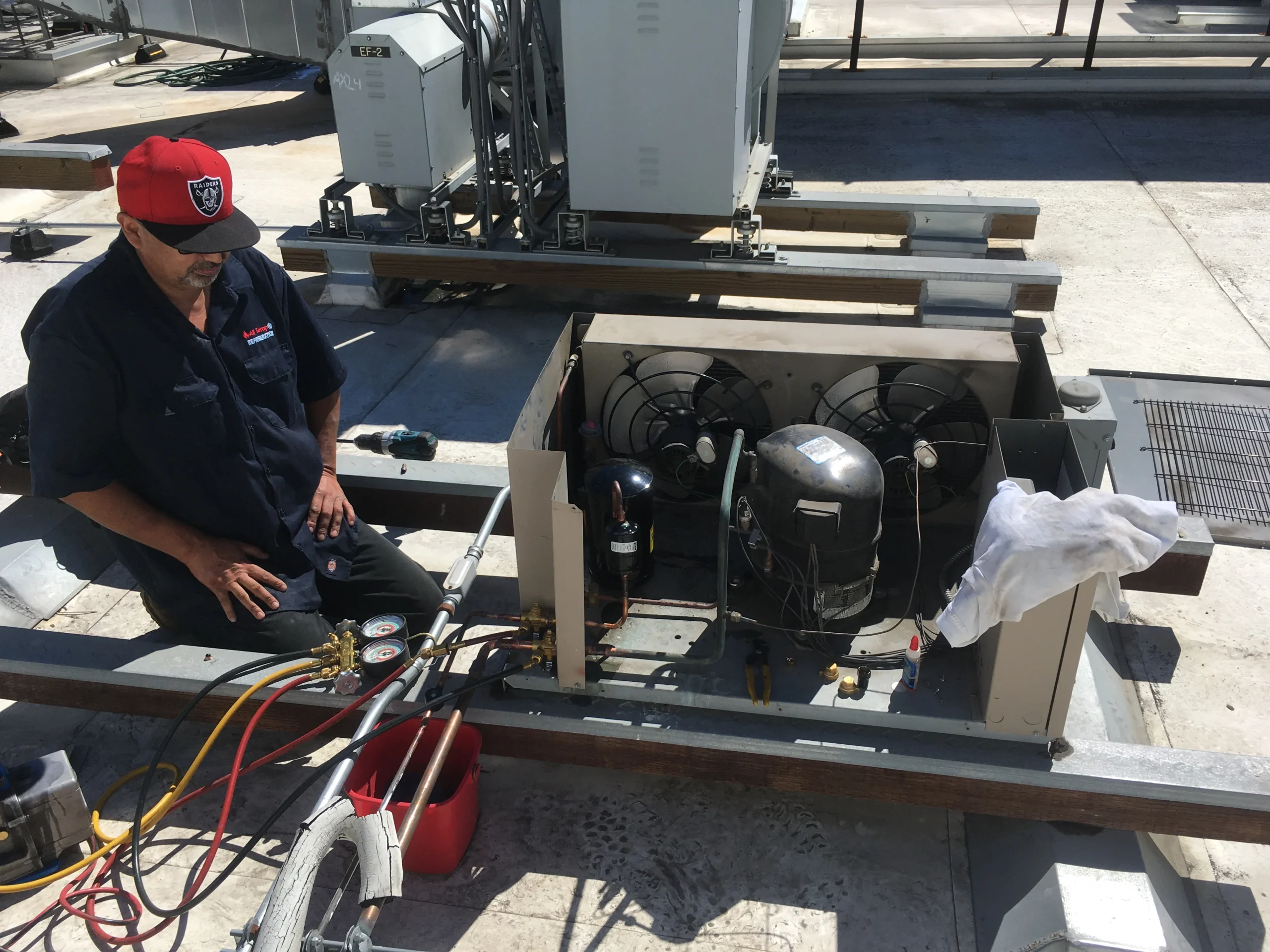
Refrigerant gauges connect to the service ports on your outdoor unit. They tell us the pressure of the refrigerant in both the high-side (condenser) and low-side (evaporator) of the system. However, pressure alone is only half the story. Modern digital manifolds also calculate saturation temperatures in real-time, giving us a much clearer picture of how the refrigerant is changing state inside the coils. This is critical for assessing the health of the compressor and the efficiency of the cooling cycle.
Temperature probes and thermal measurement tools
Temperature tells us how well the system is transferring heat. Technicians use highly accurate digital temperature probes clamped directly to the copper lines to measure pipe temperature. We also use psychrometers to measure the temperature and humidity of the air entering and leaving the system. By comparing these temperature readings with pressure readings, we get a complete view of the system’s performance.
How Advanced Diagnostics Prevent Misdiagnosis
The biggest benefit of using these tools is the ability to confirm a failure before ordering a part. It stops the expensive game of guessing.
Why replacing “likely” parts wastes money
In many cases, two completely different failures can produce the exact same symptom. A bad capacitor and a seized compressor both result in an outdoor unit that hums but won’t start. A capacitor costs a fraction of what a compressor costs. Without testing the electrical values, a lazy technician might condemn the compressor, costing you thousands of dollars unnecessarily. Diagnostic testing reveals the truth before any money is spent.
How data confirms what actually failed
When a technician tells you a part is bad, they should be able to show you the data that proves it. “Your capacitor is rated for 45 microfarads, but my meter shows it’s only holding 5.” That is a confirmed failure. There is no guesswork involved. This level of confirmation gives you peace of mind that you are paying for a necessary repair, not just a technician’s hunch.
Electrical Diagnostics That Catch Failures Early
Electrical components often give warning signs long before they completely fail. With the right tools, we can catch these issues during maintenance or minor repairs, preventing a total system shutdown later.
Identifying weak capacitors before they fail
Capacitors don’t always fail instantly; they often degrade over time. A multimeter allows us to measure the capacitance and see if it has dropped below the manufacturer’s specified tolerance range. If a capacitor is supposed to be 35 microfarads but reads 30, it’s on its way out. Catching this early prevents it from straining the compressor and causing a breakdown on the hottest day of the year.
Voltage drop and amperage testing under load
Loose connections cause voltage drops, which generate heat and kill motors. By measuring voltage across a contactor or switch while the system is running (under load), we can spot these poor connections even if they look tight to the naked eye. Similarly, checking the amperage draw of a motor tells us if it’s working harder than it should be, which is often an early sign of bearing wear or internal winding issues.
Refrigerant Diagnostics That Protect Compressors
The compressor is the heart of your HVAC system, and it relies entirely on proper refrigerant flow to stay cool and lubricated. Accurate refrigerant diagnostics are the key to protecting this expensive component.
Why pressure readings alone aren’t enough
Old-school technicians relied heavily on “beer can cold”—feeling the suction line to see if it was cold. This is not a diagnostic method; it’s a guess. Even relying solely on pressure gauges can be misleading because pressure fluctuates with outdoor temperature. A system might look like it has normal pressure but actually be starving the compressor of cooling refrigerant gas.
Superheat and subcooling explained in real terms
To truly understand the refrigerant cycle, we measure two critical values: superheat and subcooling.
- Superheat ensures that only gas (not liquid) enters the compressor. Liquid refrigerant will destroy a compressor instantly.
- Subcooling ensures that a full column of liquid is feeding the metering device for maximum efficiency.
These values are calculated using both pressure and line temperature. If a technician isn’t measuring superheat and subcooling, they aren’t properly charging your system. They are just guessing.
Airflow Testing and System Balance Diagnostics
Airflow is the most overlooked aspect of HVAC performance. You can’t diagnose an airflow problem by just holding your hand up to a vent. You need to measure the static pressure.
Static pressure testing and what it reveals
Static pressure is the resistance the blower fan has to push against. Think of it like blood pressure for your HVAC system. We use a manometer to measure the pressure in the supply and return ducts. High static pressure tells us the ductwork is undersized, restricted, or that the filter is too dirty. This data point is often the key to solving chronic overheating or cooling issues that no amount of refrigerant adjustment will fix.
How airflow problems mimic mechanical failure
A system with low airflow can cause the indoor coil to freeze up. A technician without airflow tools might assume the system is low on refrigerant and add more. This overcharges the system and creates a new problem without fixing the old one. By measuring static pressure first, we can identify that the issue is airflow, not refrigerant, saving you from a misdiagnosed repair.
Diagnostic Tools Used on Modern HVAC Systems
As HVAC technology advances, systems are becoming more computerized. The tools we use have had to evolve to keep up with these smart systems.
Control boards, fault codes, and system communication
Modern furnaces and air handlers often have sophisticated control boards that monitor their own operation. When something goes wrong, they flash a specific LED error code. While these codes point us in the right direction, they are rarely the final answer. “Pressure switch open” is a code, but the reason it’s open requires further testing with manometers and multimeters. We also use tools to verify that the thermostat is communicating correctly with the equipment, especially in complex communicating systems.
Inverter and heat pump diagnostic challenges
High-efficiency inverter systems and heat pumps don’t run at a constant speed; they ramp up and down. This makes traditional diagnostics difficult. We use specialized true-RMS meters and manufacturer-specific diagnostic tools to analyze the variable frequency drive (VFD) signals and complex sensor arrays in these units. Attempting to fix an inverter system with basic analog tools is nearly impossible.
Why Older Diagnostic Methods Fall Short
The HVAC industry has changed, but unfortunately, not every technician has kept up. Relying on outdated methods in a modern world leads to poor results.
Visual inspections without measurements
Looking at a part tells you very little about its internal health. A wire can look perfect on the outside but be broken internally. A coil can look clean on the surface but be impacted with dirt deep between the fins. Visual inspection is just the starting point; without measurement tools to verify what we see, we are flying blind.
Why experience alone isn’t enough anymore
Experience is invaluable, but it’s not a substitute for data. Even a technician with 30 years of experience cannot feel the difference between 24 volts and 18 volts. Modern systems are far less tolerant of operational variances than the tanks built in the 1980s. Precision is required, and precision comes from tools, not just intuition.
How Diagnostic Tools Reduce Repair Time — Not Increase It
Some people worry that extensive testing takes too long. In reality, it shortens the overall service timeline by ensuring the job is done once.
Faster confirmation means fewer callbacks
Spending 20 minutes to accurately diagnose a problem is far faster than spending two hours replacing the wrong part, leaving, and then having to come back the next day when the system breaks again. Diagnostics prevent the dreaded “callback,” which is frustrating for you and inefficient for us.
Why accurate testing prevents second visits
When we order a part, we want to be 100% sure it will fix the problem. Diagnostic tools give us that certainty. This means we can often get the repair done in a single trip if the part is on the truck, or order the correct part immediately if it isn’t. It eliminates the “let me try this and see if it works” phase of the repair.
Diagnostic Data vs Sales-Driven Repairs
At Cool Aid, we use diagnostics to inform, not to upsell. Data is the ultimate tool for transparency.
Why real diagnostics limit upselling
When a technician guesses, they often recommend replacing more than is necessary “just to be safe.” Diagnostic data allows for surgical precision. If the data says the motor is bad but the capacitor is good, we only replace the motor. We don’t need to pad the bill with unnecessary parts because the data guides the scope of work.
Data-based recommendations homeowners can trust
We believe in showing our work. If we recommend a repair, we can show you the meter reading or the pressure gauge that justifies it. This transparency builds trust. You don’t have to take our word for it; you can look at the numbers yourself. It shifts the conversation from a sales pitch to a factual discussion about the condition of your equipment.
When Diagnostic Tools Reveal Bigger System Issues
Sometimes, the data tells us a hard truth: the system is beyond a reasonable repair. But even then, having the data makes the decision easier.
Identifying systems near end-of-life
If our diagnostics reveal that the compressor valves are weak, the fan motor is drawing high amps, and the heat exchanger shows signs of stress, the data is painting a picture of a system at the end of its life. This allows us to give you an honest assessment. We aren’t just saying “it’s old”; we are identifying multiple specific points of failure that make replacement the more logical financial choice.
Using data to plan repairs instead of reacting
Diagnostic testing allows for proactive planning. If we see a component drifting out of spec but still working, we can let you know. You might choose to replace it now, or you might choose to budget for it next season. Either way, the data puts you in control of your HVAC maintenance, rather than waiting for an emergency to dictate your schedule.
What Homeowners Should Expect From a Proper Diagnostic Visit
When you hire a professional HVAC company, you are paying for their expertise and their diagnostic capabilities. You should expect to see them using tools.
Measurements, explanations, and clear findings
A professional technician shouldn’t just walk out to the unit and come back five minutes later with a price. You should see them opening panels, attaching gauges, and using meters. When they explain the problem, they should be able to reference specific findings: “Your system pressure is high because the condenser coil is blocked,” not just “It needs cleaning.”
Red flags that signal guess-based repairs
Be wary of technicians who don’t use tools. If someone tries to add refrigerant without hooking up gauges, or condemns a compressor without testing the electrical components, stop them. These are red flags that they are guessing with your money.
How Cool Aid Uses Diagnostics to Fix Systems Right the First Time
At Cool Aid A/C & Refrigeration, we equip our technicians with the best diagnostic tools in the industry because we respect your time and your budget.
Tool-driven troubleshooting, not assumptions
We don’t rely on assumptions. We follow a strict diagnostic process on every call, using advanced meters and sensors to isolate the exact cause of the failure. This discipline ensures that we catch problems others miss and fix issues permanently.
Repairs based on evidence, not estimates
Our recommendations are always based on hard evidence. We verify our diagnosis with data before we ever loosen a bolt or quote a price. It’s the only way to do business honestly and effectively.
If you want a repair that is rooted in accuracy, not guesswork, contact Cool Aid A/C & Refrigeration. Let us use our advanced diagnostic tools to get to the bottom of your HVAC issues and provide you with a solution that lasts.
Stay Comfortable Year-Round With Expert HVAC Service
Book a trusted technician to handle your heating or cooling issue—fast, professional, and done right the first time.
Book Service Now