I Want

    Residential HVACCommercial HVACRefrigerationEmergency HVAC


    Fast | No obligation

    Rooftop HVAC Repair vs Replacement: How to Decide

    For any facility manager or business owner, the sound of silence from the rooftop is a dreaded signal. When a commercial HVAC unit stops working, the immediate reaction is often a mix of frustration and financial anxiety. You are suddenly faced with one of the most significant operational questions in facility management: Do you patch up the old unit to keep it limping along, or do you bite the bullet and invest in a brand-new system?

    It is rarely a simple choice. A repair might seem cheaper today, but if that unit breaks down again in three months, you are throwing good money after bad. Conversely, a full replacement is a major capital expenditure that requires budgeting and planning, but it offers long-term reliability and lower energy bills.

    This decision-making process requires more than a guess; it requires a calculation. You need to weigh the age of the equipment, the frequency of recent breakdowns, energy efficiency ratings, and the immediate cost of the repair against the value of the asset.

    In this comprehensive guide, we will break down the critical factors you must evaluate to decide between rooftop HVAC repair and replacement. By the end of this article, you will have a clear framework to make a financially sound decision that protects your bottom line and ensures business continuity.

    The High Stakes of Commercial HVAC Decisions

    Unlike residential systems, where a breakdown might mean an uncomfortable night’s sleep, a commercial HVAC failure has direct, quantifiable consequences on your revenue.

    • Retail: Customers will leave a hot store, and they likely won’t return.
    • Restaurants: Dining rooms become unbearable, and kitchen staff face safety hazards.
    • Offices: Employee productivity plummets as temperatures rise.
    • Tech/Data: Server rooms can overheat, risking catastrophic data loss.

    Because the stakes are so high, the decision to repair or replace isn’t just about the cost of the hardware; it’s about risk management. The goal is to minimize downtime and maximize the predictability of your facility’s expenses.

    Factor 1: The Age of the Equipment

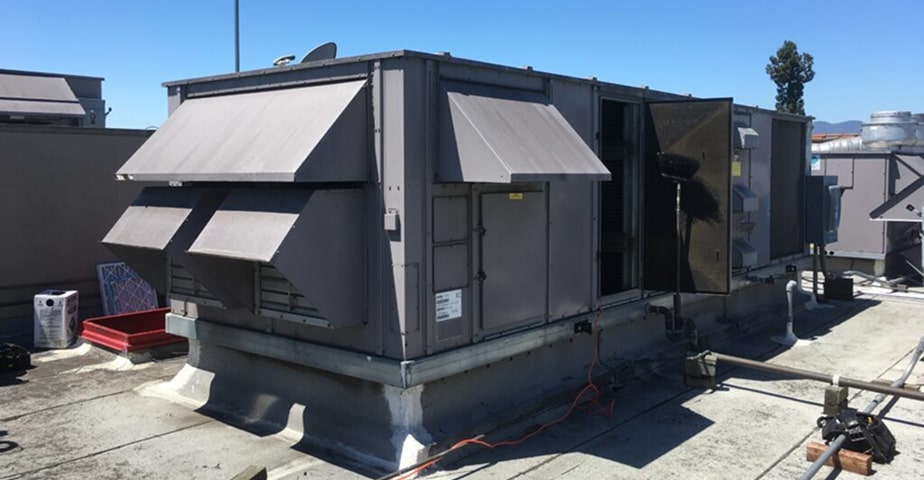
    The single most influential factor in your decision is the chronological age of the unit. Rooftop units (RTUs) live a hard life. They are exposed to blazing sun, torrential rain, wind, and hail 24 hours a day, 365 days a year.

    The ASHRAE Standard

    According to the American Society of Heating, Refrigerating and Air-Conditioning Engineers (ASHRAE), the average life expectancy of a commercial rooftop unit is 15 to 20 years.

    • Under 10 Years Old: Unless the unit has been severely neglected or suffered catastrophic damage (like a lightning strike), repair is almost always the better option. The unit still has plenty of serviceable life left.
    • 10 to 15 Years Old: This is the “gray zone.” Major repairs in this window require careful scrutiny. You must look at the overall condition of the unit. Is the cabinet rusting? Are the coils disintegrating?
    • Over 15 Years Old: The unit is living on borrowed time. Even if it is running, efficiency has likely degraded significantly. Major repairs on a unit this old are risky investments because another component is likely to fail soon after.

    The Problem of Obsolescence

    Age isn’t just about wear and tear; it’s about parts availability. As units age, manufacturers stop producing OEM parts. If your technician has to source a generic motor or wait three weeks for a specific control board to be shipped from a warehouse halfway across the country, your downtime increases significantly. Replacing an aging unit ensures that parts are readily available off the shelf.

    Factor 2: The 50% Rule and Financial Thresholds

    When you are staring at a quote for a major repair—say, a compressor replacement or a cracked heat exchanger—you need a mathematical rule of thumb to guide you. The industry standard is the 50% Rule.

    The Rule: If the cost of the repair approaches or exceeds 50% of the value of the system (or the cost of a new system), you should replace it.

    However, for commercial entities, the math can be more nuanced.

    The $5,000 Threshold (The “Assume-the-Worst” Approach)

    Many facility managers use a “repair cap.” For example, if a repair quote comes in under $1,000, it is approved automatically. If it is between $1,000 and $3,000, it requires review. If it exceeds $5,000, replacement discussions begin immediately.

    Cumulative Repair Costs

    Do not look at the repair quote in a vacuum. Look at the history of the unit over the last 24 months.

    • Did you replace a fan motor six months ago ($800)?
    • Did you fix a refrigerant leak last year ($1,200)?
    • Are you now facing a compressor failure ($3,500)?

    In this scenario, you have spent (or are about to spend) $5,500 on a unit that might only cost $12,000 to replace entirely. Those cumulative “Band-Aid” fixes are draining your budget. Investing in commercial HVAC replacement services stops the bleeding and gives you a warranty that covers future failures.

    Factor 3: The Efficiency Equation (SEER and IEER)

    A 20-year-old rooftop unit is an energy vampire. HVAC technology has advanced rapidly in the last two decades, driven by stricter Department of Energy (DOE) regulations.

    Understanding the Ratings

    • SEER (Seasonal Energy Efficiency Ratio): Measures cooling efficiency over a typical cooling season.
    • IEER (Integrated Energy Efficiency Ratio): This is more critical for commercial units. It measures efficiency at part-load operation (when the unit isn’t running at 100% capacity), which is how commercial units run most of the time.

    The Cost of “Business as Usual”

    An old unit might have a SEER rating of 8 or 10. Modern standard-efficiency units start at 14 SEER, and high-efficiency models go much higher.

    The Math: Replacing a 10 SEER unit with a 15 SEER unit can reduce your cooling energy consumption by roughly 33%.
    If your business spends $2,000 a month on electricity for HVAC, saving 33% puts $660 back in your pocket every month. That is nearly $8,000 a year in savings. Over a 5-year period, the new unit essentially pays for a large portion of itself purely in energy savings.

    When weighing repair vs. replacement, calculate the “hidden cost” of keeping the inefficient unit running. A cheap repair might actually cost you thousands more in utility bills over the next few years.

    Factor 4: The R-22 Refrigerant Phase-Out

    If your rooftop unit was manufactured before 2010, there is a high probability it uses R-22 refrigerant (often known by the brand name Freon).

    The Ban is in Effect

    As of January 1, 2020, the production and import of R-22 was completely banned in the United States due to its environmental impact on the ozone layer.

    • Scarcity: You can still use R-22 systems, but the only refrigerant available is recycled or reclaimed stock.
    • Cost: Because supply is shrinking and demand remains, the price of R-22 has skyrocketed. A simple refrigerant recharge that used to cost a few hundred dollars can now cost thousands.

    The Retrofit Myth

    Some business owners ask, “Can’t we just put a different refrigerant in it?” Sometimes, yes, but it’s rarely a good idea. “Drop-in” replacements often reduce cooling capacity and can damage seals and oil in the compressor.

    If your R-22 unit has a major leak or compressor failure, investing money into it is widely considered a poor financial decision. You are investing in obsolete technology that will only get more expensive to maintain. This is a clear signal to utilize commercial HVAC replacement services.

    Factor 5: Frequency of Breakdowns and Reliability

    How much is your peace of mind worth? How much is your time worth?

    If you are on a first-name basis with your repair technician because they are at your facility every other month, your unit has become a liability.

    • Soft Costs: Beyond the invoice for the repair, consider the administrative time spent scheduling visits, managing tenant complaints, and dealing with uncomfortable working conditions.
    • The Domino Effect: In older systems, when one major component fails, it often stresses other components. A seized compressor might have contaminated the refrigerant lines. A wobbly fan might have cracked the structural housing.

    If a unit has become unreliable, a repair is only buying you time until the next failure. A new system restores reliability, allowing you to focus on running your business rather than managing your building’s temperature.

    Factor 6: Comfort and Air Quality Issues

    Sometimes, a unit “works” in the sense that it turns on, but it fails to do its job effectively.

    • Humidity Control: Old units often struggle to remove humidity, leading to a clammy feeling indoors, potential mold growth, and odors (“dirty sock syndrome”).
    • Uneven Temperatures: If one office is freezing and the next is boiling, the unit may have lost compression or airflow capacity.
    • Noise: As bearings wear out and panels loosen, older RTUs can become incredibly noisy, disrupting employees and customers.

    If repairing the mechanical failure doesn’t solve the underlying comfort issues, replacement is the superior option. Modern units often come with variable speed fans and multi-stage compressors that provide precise temperature control and superior dehumidification.

    The “5000 Rule” Calculation

    If you want a quick, back-of-the-napkin calculation to help you decide, many facility managers use the “5000 Rule.”

    Formula: Age of the Unit (in years) × Cost of Repair (in dollars)

    • If the total is less than $5,000, Repair it.
    • If the total is more than $5,000, Replace it.

    Example A:

    • Unit is 5 years old.
    • Repair is $600.
    • 5 × 600 = 3,000.
    • Verdict: Repair.

    Example B:

    • Unit is 12 years old.
    • Repair is $500.
    • 12 × 500 = 6,000.
    • Verdict: Replace.

    Example C:

    • Unit is 15 years old.
    • Repair is $400.
    • 15 × 400 = 6,000.
    • Verdict: Replace.

    This rule weighs age heavily, protecting you from sinking money into a pit, even if the repair seems cheap.

    The Role of Maintenance History

    Your decision should also be informed by how well the unit has been cared for. A 15-year-old unit that has had quarterly filter changes, belt replacements, and coil cleanings is very different from a 10-year-old unit that has been ignored.

    If you have a robust history of commercial HVAC maintenance, the internal components might be cleaner and less stressed, justifying a repair on an older unit. However, if the unit has been neglected, the internal wear is likely far worse than what you can see on the surface. Dirt on coils increases head pressure, which shortens compressor life. If a neglected unit fails, it is often the start of a cascade of failures.

    Financial Incentives: Tax Write-Offs and Rebates

    One often-overlooked factor in the “Replace” column is the tax benefit.

    • Section 179: Under US tax code Section 179, businesses can often deduct the full purchase price of qualifying equipment (including HVAC systems) financed or purchased during the tax year. This can significantly offset the upfront cost of a new unit.
    • Utility Rebates: Local utility companies (like PG&E in California) often offer substantial rebates for upgrading to high-efficiency commercial equipment. These rebates can cover a chunk of the installation cost.

    Always consult your accountant, but realized tax savings can sometimes make a new unit cheaper in the first year than a major repair.

    When Repair Is the Right Choice

    Despite the benefits of new technology, replacement isn’t always the answer. Repair is the logical choice when:

    1. The Unit is New: If the system is under 10 years old and well-maintained.
    2. The Problem is Minor: Electrical components (capacitors, contactors), belts, or fan motors are relatively inexpensive routine repairs.
    3. Warranty Coverage: If the unit or the compressor is still under the manufacturer’s warranty, the cost of repair drops drastically (usually covering parts, though you pay for labor).
    4. Cash Flow Constraints: Sometimes, businesses simply don’t have the capital for a replacement right now. In this case, a repair is a necessary stopgap. However, start budgeting for replacement immediately.

    If you opt for repair, ensure you are using a reputable provider for commercial HVAC repair services who will do the job right, rather than applying a temporary patch.

    The Replacement Process: What to Expect

    If you decide that replacement is the smarter path, it helps to know what lies ahead. Unlike residential changes, commercial replacement is a logistical operation.

    1. Load Calculation: A good contractor won’t just swap “like for like.” They will perform a load calculation to ensure the new unit is sized correctly for your building’s current needs (which may have changed since the building was built).
    2. Curb Adapters: New units rarely fit the exact footprint of old roof curbs. Custom metal curb adapters are fabricated to mate the new unit to the existing roof opening seamlessly.
    3. Crane Lift: A crane is required to lift the old unit off and set the new one. This requires safety planning and sometimes street permits.
    4. Downtime: A professional crew can often complete a swap-out in a single day, minimizing disruption to your business.

    Conclusion: Making the Smart Call

    Deciding between repairing and replacing a commercial rooftop unit is a balance of engineering and economics.

    • Choose Repair if the unit is young, the cost is low, and the history is good.
    • Choose Replacement if the unit is old (>15 years), the repair is expensive (>50% of value), the unit uses R-22, or energy bills are skyrocketing.

    The worst decision is indecision—waiting until the unit fails completely on the hottest day of the year. By that point, you lose the luxury of shopping for the best price or planning the installation; you are at the mercy of emergency availability.

    Take a proactive approach. Review your equipment logs, check the age of your units, and consult with a professional. At 1-800-CoolAid, we help businesses across the Bay Area evaluate their HVAC assets honestly. Whether you need a precision repair to extend a unit’s life or a seamless replacement to secure your future comfort, we provide the data and expertise you need to decide with confidence.

    Don’t let your HVAC system manage you. Manage your system, and keep your business running smoothly.

    Frequently Asked Questions (FAQs)

    Can I replace just the compressor instead of the whole unit?

    Yes, replacing a compressor is a common repair. However, it is expensive. If the unit is over 12-15 years old, putting a new compressor in an old shell is risky. The other components (coils, fans, heat exchangers) are still old and liable to fail, potentially wasting the investment in the new compressor.

    How long does a commercial HVAC replacement take?

    For a standard rooftop unit swap, the actual work can often be done in one day. However, the lead time for ordering the unit and fabricating the curb adapter can take a few days to a few weeks, depending on availability.

    Will a new unit really lower my bills?

    Almost certainly. If you are replacing a 15-year-old unit, the efficiency gains from modern compressors and fan motors are substantial. Many businesses see ROI in 3-5 years purely from energy savings.

    What happens if I don’t replace my R-22 unit?

    You can keep running it, but if it develops a leak, repairing it will be incredibly expensive due to the scarcity of R-22 refrigerant. Eventually, you will be forced to replace it when the refrigerant is no longer obtainable or affordable.

    Is financing available for commercial HVAC replacement?

    Yes, many HVAC companies offer financing options, and equipment leasing is also popular for businesses who want to keep capital reserves intact while upgrading their infrastructure.


    Stay Comfortable Year-Round With Expert HVAC Service

    Book a trusted technician to handle your heating or cooling issue—fast, professional, and done right the first time.

    Book Service Now
    Blog post Image
    Blog post Image
    Blog post Image

    Frequently Asked Questions

    How do I know when condensing unit replacement is better than repair?

    Consider replacement when repair costs exceed 50% of replacement cost, when units are over 12-15 years old, or when efficiency losses significantly increase energy bills. We provide cost-benefit analysis to help you make the right decision for your specific situation.

    What energy savings can I expect from a new high-efficiency condensing unit?

    Modern units typically achieve 20-40% energy savings compared to units installed before 2010. For a business spending $500 monthly on refrigeration energy, this represents $100-200 monthly savings that often pays for replacement within 3-5 years.

    How long does condensing unit replacement take?

    Most replacements take 1-3 days depending on unit size and installation complexity. We coordinate work around your business schedule to minimize disruption and can often provide temporary cooling during installation when necessary.

      Schedule Your Service

      Stay Comfortable Year-Round With Expert HVAC Service

      Book a trusted technician to handle your heating or cooling issue—fast, professional, and done right the first time.

      Schedule a FREE Discovery Call
      Close

      Schedule Your Service